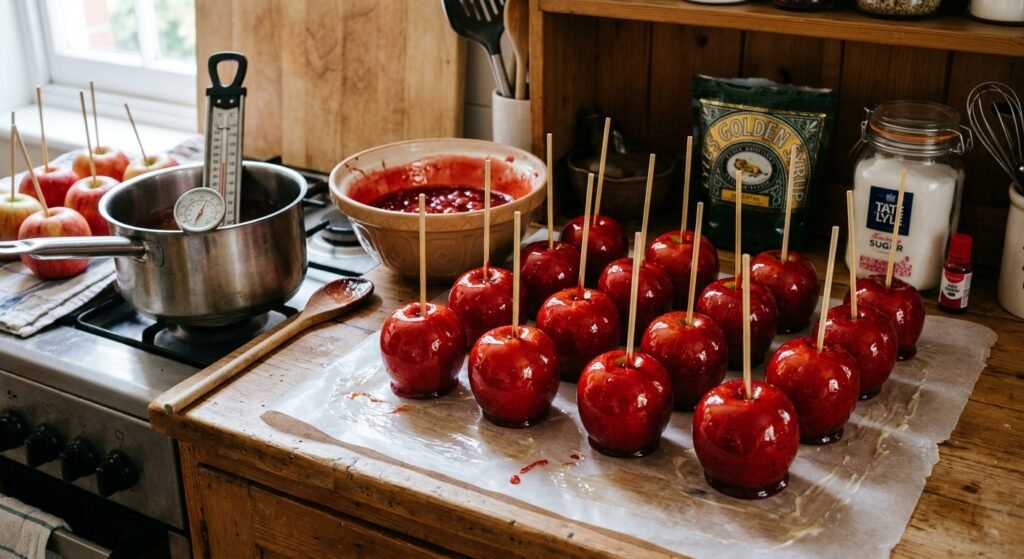
Toffee Apples are a nostalgic favourite that bring a little fairground magic to any celebration. Crisp, juicy apples are coated in a glossy red sugar shell that hardens into a deliciously crunchy layer, creating a wonderful contrast between the fresh fruit and sweet toffee.
Made with sugar, golden syrup and a little red food colouring, this classic confection is surprisingly simple in its ingredients. The secret is cooking the syrup to the correct temperature so that it sets into a crisp, glass-like coating rather than remaining sticky.
Perfect for Halloween parties, festive gatherings, school fêtes or a special homemade treat, these colourful apples are as lovely to display as they are to enjoy. Wrap them individually for a fun party favour or serve them fresh once the coating has hardened.
Butter or neutral cooking oil, for greasing the baking paper
Method:
Prepare the apples:
Wash the apples thoroughly and remove any stickers.
If the apples have a waxy coating, briefly dip them in hot water to help remove it, then dry them thoroughly.
Make sure the apples are completely dry, as moisture can prevent the toffee from sticking.
Remove the stalks and insert a skewer firmly into the stem end of each apple.
Arrange the prepared apples on a tray lined with baking paper.
Prepare the setting area:
Line several baking trays with baking paper.
Lightly grease the paper with butter or neutral cooking oil to prevent the toffee from sticking.
Keep the trays close to where the apples will be dipped.
Prepare the golden syrup:
If the golden syrup is too thick to measure easily, stand its closed container in warm water for a short while.
Use a clean, dry measuring cup and spoon to measure the syrup.
Cook the sugar mixture:
Place the water and sugar in a large, heavy-based saucepan.
Heat gently, stirring until the sugar has dissolved.
Add the salt and golden syrup, then stir to combine.
Bring the mixture to a boil and cook without stirring until it reaches 149–154°C, the hard-crack stage.
Use a reliable sugar thermometer to check the temperature. This high temperature is essential for creating a crisp coating that hardens properly.
Add the red colouring:
Once the syrup reaches the correct temperature, carefully remove the saucepan from the heat.
Add a few drops of red food colouring and gently swirl the pan to distribute the colour.
Avoid vigorous stirring, which can encourage sugar crystallisation.
Coat the apples:
With an adult handling the hot syrup, carefully dip each apple into the toffee mixture.
Turn the apple gently to coat it evenly, then lift it out and allow excess syrup to drip back into the saucepan.
Work carefully and keep hands away from the hot mixture, as boiling sugar can cause serious burns.
If the syrup begins to thicken while dipping, it can be kept gently warm, but do not allow it to boil again unnecessarily.
Allow the coating to harden:
Place each coated apple on the prepared baking paper with the skewer pointing upwards.
Leave the apples undisturbed until the toffee has completely hardened.
Allow them to cool fully before handling or wrapping.
Serve and enjoy:
Once the coating is crisp and firm, carefully lift the apples from the baking paper.
Serve fresh or wrap individually in clear cellophane for parties and festive gifts.
A classic sweet treat with a glossy, candy-coated crunch. 😊 Enjoy making your toffee apples! 🍏
Why You’ll Love These Homemade Toffee Apples
Classic nostalgic flavour: A crisp red coating and juicy apple create a traditional sweet-shop favourite.
Beautiful glossy finish: Red food colouring gives the apples their familiar festive appearance.
Simple ingredients: Sugar, golden syrup and fresh apples are all you need for the basic recipe.
Perfect for celebrations: A colourful addition to Halloween parties, fêtes and festive gatherings.
Fun to customise: Experiment with different colours, toppings and flavour additions.
Lovely homemade gifts: Individually wrapped apples make cheerful party favours and edible gifts.
Tips for the Best Toffee Apples
Choose firm apples: Crisp varieties such as Granny Smith, Pink Lady or Golden Delicious work well because they hold their shape and provide a refreshing contrast to the sweet coating.
Remove excess wax: A waxy apple surface can prevent the toffee from adhering properly.
Dry the apples completely: Even a little moisture can cause the coating to slide off or become patchy.
Use a sugar thermometer: The hard-crack stage is approximately 149–154°C. A thermometer gives a more reliable result than judging the syrup by appearance.
Avoid stirring once boiling: Stirring the syrup after the sugar has dissolved can encourage crystallisation.
Prepare everything beforehand: Have the skewered apples and greased trays ready before cooking the syrup.
Work promptly: The syrup begins to thicken as it cools, so coat the apples while it is still fluid.
Keep children away from the hot syrup: Boiling sugar is extremely hot and can cause serious burns. An adult should handle the cooking, dipping and moving of the hot saucepan.
Allow the coating to set completely: Do not wrap or store the apples while the toffee is still warm or sticky.
Uses for Homemade Toffee Apples
Toffee Apples are a festive treat that can be enjoyed in several fun ways:
Fairground favourite: Serve them as a nostalgic sweet at fêtes, carnivals and family celebrations.
Halloween treats: Add them to a colourful Halloween dessert table.
Party favours: Wrap individual apples in clear cellophane and finish with decorative ribbon.
Festive gifts: Arrange them in a gift basket with other homemade sweets.
Dessert decorations: Use small pieces of broken toffee coating as a crunchy decoration for suitable desserts.
Creative decorating: Add sprinkles or finely chopped nuts while the coating is still slightly tacky, provided they are suitable for the intended occasion.
Storage and Reheating
Best enjoyed fresh: Toffee Apples have the best crunch when eaten on the day they are made.
Room-temperature storage: Keep completely cooled apples in a cool, dry place, away from direct sunlight and humidity.
Avoid refrigeration: Moisture in the refrigerator can make the hard toffee coating sticky.
Wrapping: Once fully hardened, wrap each apple individually in cellophane or food-safe packaging.
Storage time: For the best quality, enjoy within 1–2 days. The fresh apples can release moisture over time, affecting the coating.
Do not reheat: The toffee coating should not be reheated once it has set.
What to Serve with Toffee Apples
The sweet, crunchy coating and fresh apple flavour pair beautifully with a selection of drinks and lighter treats.
Fresh fruit platter: Strawberries, grapes and berries provide a refreshing contrast.
Dark chocolate: A little dark chocolate balances the sweetness of the toffee.
Shortbread biscuits: Their buttery, crumbly texture makes a lovely accompaniment.
Caramel apple dip: A small bowl of caramel dip creates an extra-indulgent apple-themed treat.
Apple and Brie tartlets: A sweet-and-savoury pairing for a festive dessert spread.
Warm spiced tea: Cinnamon or rooibos tea complements the caramel-like flavour.
Strong coffee: A cup of coffee provides a pleasant contrast to the sweet coating.
Here are some fun variations to experiment with for your Toffee Apples recipe:
Variations
Chocolate-Dipped Toffee Apples: Once the toffee has hardened, drizzle the apples with melted dark or white chocolate.
Nutty Crunch: Sprinkle finely chopped peanuts, almonds or pecans over the coating while it is still slightly tacky.
Spiced Toffee Apples: Add a small pinch of cinnamon or mixed spice to the sugar mixture before it comes to the boil.
Rainbow Toffee Apples: Use different food colouring shades to create colourful apples for parties.
Salted Toffee Apples: Add a tiny pinch of flaky sea salt to the finished coating for a sweet-and-salty contrast.
Chocolate and Sprinkle Apples: Decorate the hardened toffee coating with a little melted chocolate and colourful sprinkles.
Cinnamon Sugar Apples: Sprinkle a little cinnamon sugar over the apples while the coating is still slightly tacky.
Green Toffee Apples: Use green food colouring for a fun alternative to the traditional red version.
Final Thoughts
Homemade Toffee Apples are a timeless sweet treat that bring colour, crunch and a little nostalgia to any occasion. The combination of crisp apples and a glossy, hard red coating makes them a delightful favourite for Halloween celebrations, festive gatherings and homemade gifting.
The key to success is preparing completely dry apples and cooking the sugar syrup to the correct hard-crack temperature. With a little care and an adult handling the hot syrup, you can create beautiful candy-coated apples that look as lovely as they taste.
Frequently Asked Questions
Why isn’t the toffee sticking to my apples?
The apples may have a waxy coating or moisture on their skins. Wash them thoroughly, remove excess wax and dry them completely before dipping. A clean, dry surface helps the toffee adhere.
Why is my toffee coating sticky?
The syrup may not have reached the hard-crack stage. For a crisp coating, it needs to reach approximately 149–154°C. Humidity can also affect how well the coating sets.
What apples are best for toffee apples?
Firm, crisp apples are ideal. Granny Smith apples are particularly good because their slight tartness balances the sweetness of the coating, while Pink Lady and Golden Delicious are also suitable choices.
Can I make Toffee Apples without food colouring?
Yes. The food colouring is optional. Without it, the apples will have a clear, golden toffee coating rather than the traditional bright red finish.
Can I make Toffee Apples ahead of time?
They are best made on the day they will be served. The apple can release moisture over time, which may soften the toffee coating and make it sticky.
Why has my sugar syrup crystallised?
Crystallisation can happen if the syrup is stirred while boiling or if sugar crystals remain on the sides of the saucepan. Allow the sugar to dissolve fully before boiling and avoid stirring once the mixture reaches a boil.
Can I use honey instead of golden syrup?
Golden syrup is recommended for this recipe because it contributes to the flavour and texture of the coating. Honey has a different composition and may change the result, so it is best to use golden syrup or a suitable glucose syrup.
How do I know when the toffee is ready?
The most reliable method is to use a sugar thermometer and check that the syrup reaches 149–154°C. At this temperature, the coating should harden into a crisp shell once it cools.
Essential cookies enable basic functions and are necessary for the proper function of the website.
Name
Description
Duration
Cookie Preferences
This cookie is used to store the user's cookie consent preferences.
30 days
These cookies are needed for adding comments on this website.
Name
Description
Duration
comment_author
Used to track the user across multiple sessions.
Session
comment_author_email
Used to track the user across multiple sessions.
Session
comment_author_url
Used to track the user across multiple sessions.
Session
Google's current Sign in with Google client library. It renders the Google sign-in button, or the One Tap prompt, so visitors can log in to your site with their Google account. It replaces the older Google Sign-In platform library.
Set on your own domain by the Sign in with Google client library. Records whether the visitor has dismissed the One Tap sign-in prompt and for how long it should stay hidden, plus the time the library last loaded and a browsing session id used for the same purpose. Sites that pass a custom state_cookie_name will see that name instead.
180 days
g_csrf_token
Set on your own domain by the Sign in with Google client library and submitted together with the sign-in credential, so your site can confirm the sign-in came from its own page and not from a forged cross-site request.
5 minutes
Statistics cookies collect information anonymously. This information helps us understand how visitors use our website.
Google Analytics is a powerful tool that tracks and analyzes website traffic for informed marketing decisions.
Contains information related to marketing campaigns of the user. These are shared with Google AdWords / Google Ads when the Google Ads and Google Analytics accounts are linked together.
90 days
__utma
ID used to identify users and sessions
2 years after last activity
__utmt
Used to monitor number of Google Analytics server requests
10 minutes
__utmb
Used to distinguish new sessions and visits. This cookie is set when the GA.js javascript library is loaded and there is no existing __utmb cookie. The cookie is updated every time data is sent to the Google Analytics server.
30 minutes after last activity
__utmc
Used only with old Urchin versions of Google Analytics and not with GA.js. Was used to distinguish between new sessions and visits at the end of a session.
End of session (browser)
__utmz
Contains information about the traffic source or campaign that directed user to the website. The cookie is set when the GA.js javascript is loaded and updated when data is sent to the Google Anaytics server
6 months after last activity
__utmv
Contains custom information set by the web developer via the _setCustomVar method in Google Analytics. This cookie is updated every time new data is sent to the Google Analytics server.
2 years after last activity
__utmx
Used to determine whether a user is included in an A / B or Multivariate test.
18 months
_ga
ID used to identify users
2 years
_gali
Used by Google Analytics to determine which links on a page are being clicked
30 seconds
_ga_
ID used to identify users
2 years
_gid
ID used to identify users for 24 hours after last activity
24 hours
_gat
Used to monitor number of Google Analytics server requests when using Google Tag Manager
1 minute
Marketing cookies are used to follow visitors to websites. The intention is to show ads that are relevant and engaging to the individual user.
Google Ads is an online advertising platform that enables businesses to create targeted ads displayed on Google search results and partner sites.
Targeting cookie. Used to create a user profile and display relevant and personalised Google Ads to the user.
2 years
__Secure-1PSIDCC
Targeting cookie. Used to create a user profile and display relevant and personalised Google Ads to the user.
2 years
__Secure-3PAPISID
Profiles the interests of website visitors to serve relevant and personalised ads through retargeting.
2 years
AEC
AEC cookies ensure that requests within a browsing session are made by the user, and not by other sites. These cookies prevent malicious sites from acting on behalf of a user without that user's knowledge.
6 months
ADS_VISITOR_ID
Cookie required to use the options and on-site web services
2 months
__Secure-3PSIDCC
Targeting cookie. Used to create a user profile and display relevant and personalised Google Ads to the user.
2 years
__Secure-3PSIDTS
Targeting cookie. Used to create a user profile and display relevant and personalised Google Ads to the user.
2 years
__Secure-1PSIDTS
Targeting cookie. Used to create a user profile and display relevant and personalised Google Ads to the user.
2 years
__Secure-1PAPISID
Targeting cookie. Used to create a user profile and display relevant and personalised Google Ads to the user.
2 years
__Secure-3PSID
Targeting cookie. Used to profile the interests of website visitors and display relevant and personalised Google ads.
2 years
Conversion
Google uses cookies for advertising, including serving and rendering ads, personalizing ads (depending on your ad settings at g.co/adsettings), limiting the number of times an ad is shown to a user, muting ads you have chosen to stop seeing, and measuring the effectiveness of ads.
90 days
_gcl_aw
Google uses cookies for advertising, including serving and rendering ads, personalizing ads (depending on your ad settings at g.co/adsettings), limiting the number of times an ad is shown to a user, muting ads you have chosen to stop seeing, and measuring the effectiveness of ads.
90 Days
_gcl_gs
Google uses cookies for advertising, including serving and rendering ads, personalizing ads (depending on your ad settings at g.co/adsettings), limiting the number of times an ad is shown to a user, muting ads you have chosen to stop seeing, and measuring the effectiveness of ads.
90 Days
_gcl_gb
Google uses cookies for advertising, including serving and rendering ads, personalizing ads (depending on your ad settings at g.co/adsettings), limiting the number of times an ad is shown to a user, muting ads you have chosen to stop seeing, and measuring the effectiveness of ads.
90 Days
_gac_gb_
Google uses cookies for advertising, including serving and rendering ads, personalizing ads (depending on your ad settings at g.co/adsettings), limiting the number of times an ad is shown to a user, muting ads you have chosen to stop seeing, and measuring the effectiveness of ads.
90 Days
FPGCLGB
Google uses cookies for advertising, including serving and rendering ads, personalizing ads (depending on your ad settings at g.co/adsettings), limiting the number of times an ad is shown to a user, muting ads you have chosen to stop seeing, and measuring the effectiveness of ads.
90 Days
FPGCLAW
Google uses cookies for advertising, including serving and rendering ads, personalizing ads (depending on your ad settings at g.co/adsettings), limiting the number of times an ad is shown to a user, muting ads you have chosen to stop seeing, and measuring the effectiveness of ads.
90 Days
You can find more information in our Cookie Policy and .