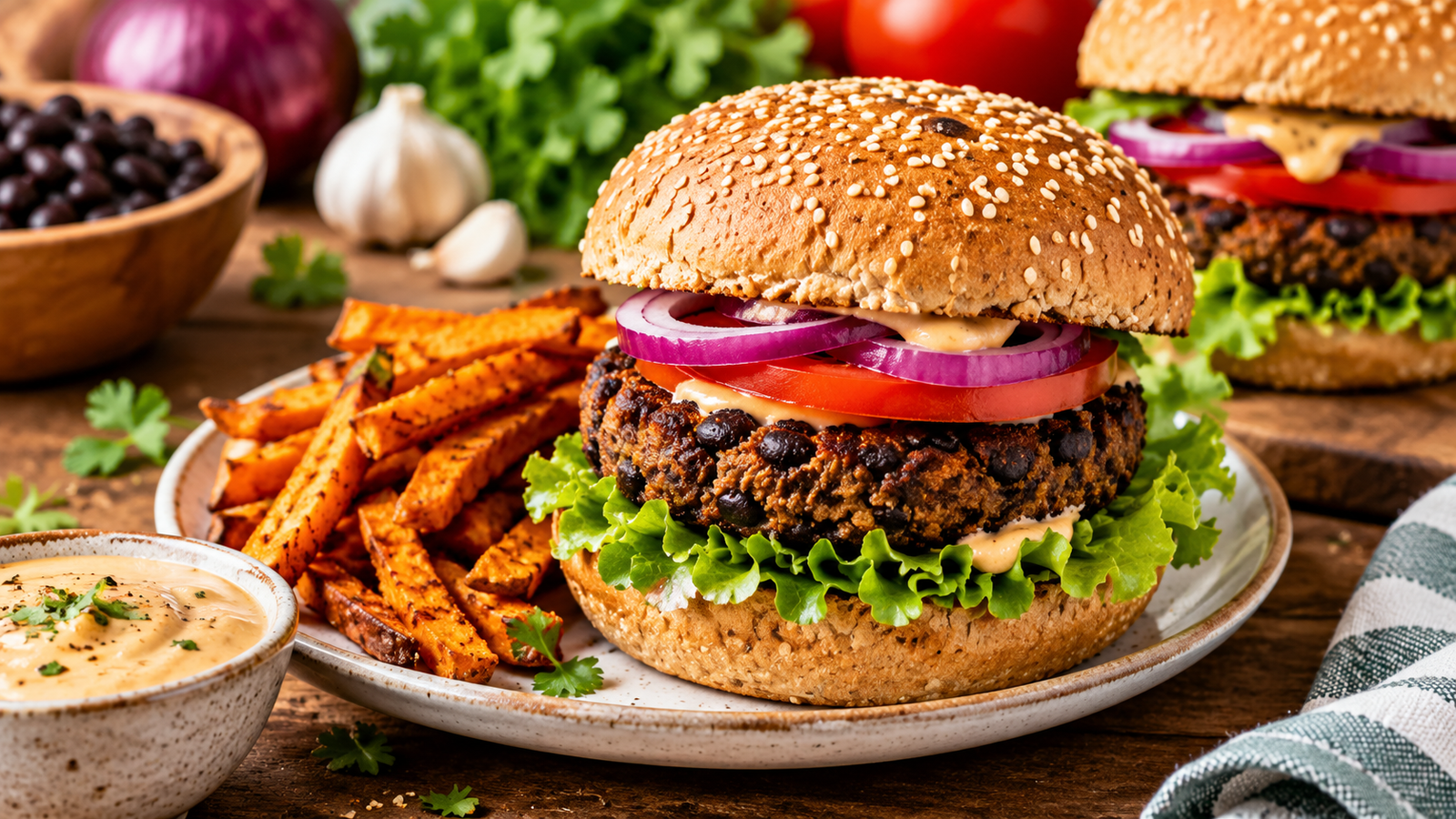
Black bean burgers are proof that a meat-free meal can be just as satisfying and flavourful as a traditional burger. Made with cooked black beans, onion, garlic, breadcrumbs and warming spices, these homemade patties have a deliciously savoury taste with a hint of smokiness from paprika and cumin.
The secret to a great black bean burger is balancing moisture and texture. Mashing the beans while leaving a few whole pieces creates a hearty base, while breadcrumbs and egg help hold the patties together. Once pan-fried, the burgers develop a golden, crispy exterior with a tender centre.
Serve them on toasted burger buns with crisp lettuce, juicy tomato, sliced onion and your favourite sauce. Whether you’re planning a quick weeknight dinner, a vegetarian braai or a casual weekend lunch, these black bean burgers are easy to customise and delicious to share.
2 cups cooked black beans, or 1 can, drained and rinsed
½ cup breadcrumbs, or finely ground oats
½ cup onion, finely chopped
2 garlic cloves, minced
1 large egg, or 1 flax egg for a vegan option
1 tbsp soy sauce
1 tsp smoked paprika
½ tsp ground cumin
½ tsp chilli powder, optional
Salt and black pepper, to taste
Olive oil, for cooking
For serving:
4 burger buns
Lettuce leaves
1–2 tomatoes, sliced
1 small onion, sliced
Pickles, optional
Your favourite burger sauce, mayonnaise or chutney
Method:
Prepare the black beans:
If using canned beans, drain and rinse them thoroughly.
Pat them dry with a clean kitchen towel or paper towel to remove excess moisture.
This helps the patties hold their shape.
Mash the beans:
Place the beans in a large mixing bowl and mash them with a fork or potato masher.
Leave some beans partially whole to create a hearty texture rather than a completely smooth paste.
Mix the ingredients:
Add the breadcrumbs, chopped onion, garlic, egg, soy sauce, smoked paprika, cumin, and optional chilli powder.
Season with salt and black pepper.
Mix until everything is evenly combined.
If the mixture feels too wet, add a little more breadcrumbs.
Shape the patties:
Divide the mixture into four equal portions and shape each into a firm patty.
Press the edges together gently to help prevent cracking during cooking.
Chill the patties:
Place the patties in the refrigerator for 10 minutes if time allows.
This helps them firm up and makes them easier to handle.
Heat the pan:
Add a thin layer of olive oil to a large frying pan and heat over medium heat.
The oil should be hot enough to sizzle gently when the patties are added.
Cook until golden:
Place the patties in the pan, leaving space between them.
Cook for approximately 4–5 minutes per side, turning carefully, until both sides are crisp and golden and the centres are hot.
Adjust the heat if the outside browns too quickly.
Assemble the burgers:
Lightly toast the burger buns if desired.
Place a black bean patty on each bottom bun and add lettuce, tomato, onion, pickles, and your favourite sauce.
Cover with the top bun and serve immediately.
Savory, satisfying, and perfect for a meatless meal. 😊
Here’s a deeper look at what makes them shine:
🌟 Key Highlights
Black beans: Nutritious base, offering protein and creaminess when mashed.
Breadcrumbs or oats: Help bind the patties and add texture.
Spices: Smoked paprika, cumin, and chili powder give a bold, savory kick.
Soy sauce: Adds umami depth, balancing the beans.
Egg or flax egg: Essential binder, with a vegan-friendly option.
Why You’ll Love These Black Bean Burgers
Meat-free and satisfying: Black beans provide a hearty base with a naturally creamy texture.
Full of flavour: Smoked paprika, cumin, garlic and soy sauce create a savoury, well-seasoned patty.
Easy to customise: Adjust the spices, add vegetables or experiment with different toppings.
Budget-friendly: The recipe uses accessible ingredients, many of which may already be in your pantry.
Perfect for sharing: Serve the burgers with a selection of toppings and sides for a relaxed family meal.
Suitable for vegan adaptations: Replace the egg with a flax egg and choose vegan-friendly buns, sauces and toppings.
Tips for the Best Black Bean Burgers
Remove excess moisture: Wet beans can make the mixture too soft. Drain, rinse and dry canned beans before mashing.
Keep some texture: Avoid blending the beans into a completely smooth paste. A little texture helps create a more substantial burger.
Adjust the binder gradually: If the mixture feels sticky or loose, add breadcrumbs a tablespoon at a time until the patties hold their shape.
Chill before cooking: Even a short rest in the refrigerator can make the patties easier to turn.
Use medium heat: Cooking too quickly can burn the outside before the centre is properly heated.
Turn carefully: Black bean patties are more delicate than meat patties, so use a wide spatula and turn them only once the first side has formed a firm crust.
Don’t overcrowd the pan: Cook in batches if necessary to maintain even browning.
Toast the buns: Lightly toasted buns add texture and help prevent the sauce from soaking into the bread.
Storage
Refrigeration: Store cooked patties in an airtight container in the refrigerator within two hours of cooking.
Storage time: Use refrigerated leftovers within 3–4 days.
Freezing cooked patties: Allow them to cool, then separate them with baking paper and freeze in a sealed container for up to 3 months for best quality.
Freezing uncooked patties: Place shaped patties on a lined tray until firm, then transfer them to a freezer-safe container with baking paper between each patty.
Reheating: Reheat in a lightly oiled frying pan over medium-low heat or in the oven until hot throughout. A microwave is convenient but may soften the crust.
Food safety: If using an egg binder, cook the patties thoroughly until the centre is hot and the egg is fully cooked.
For the best texture, reheat the patties in a frying pan or oven rather than relying on the microwave alone.
To make them part of a complete spread, here are side dishes and pairings for Black Bean Burgers that highlight their texture and spice:
🍟 Comforting & Classic
Sweet Potato Fries: Crispy, caramelized sweetness to balance the smoky patties.
Coleslaw: Creamy crunch that cools the chili heat.
Avocado Salad: Creamy, citrusy freshness to complement the beans.
Cucumber Mint Salad: Crisp, cooling contrast.
Grilled Vegetable Skewers: Smoky peppers, zucchini, and mushrooms alongside.
🌮 Playful & Bold
Chipotle Mayo: Creamy, spicy drizzle for extra kick.
Pickled Jalapeños: Tangy heat to brighten each bite.
Guacamole: Smooth, zesty topping that pairs beautifully.
🍹 Drinks & Atmosphere
IPA Beer: Hoppy bitterness to balance the smoky beans.
Margarita: Citrusy cocktail that mirrors the cumin and chili.
Sparkling Water with Lime: Refreshing sip to keep the palate light.
Here are some fun variations to experiment with for your Black Bean Burgers recipe:
Variations
🌱 Flavor Boosts
Mexican-Style Black Bean Burger: Add corn kernels, jalapeños, and cilantro; top with guacamole and salsa.
Mediterranean Twist: Mix in sun-dried tomatoes, olives, and oregano; serve with tzatziki.
Smoky BBQ Burger: Brush patties with BBQ sauce while cooking; top with caramelized onions.
Indian-Inspired Burger: Add garam masala and turmeric; serve with mango chutney and yogurt raita.
🧀 Cheese & Creamy Layers
Cheddar Melt: Add sharp cheddar slices for richness.
Goat Cheese Tang: Crumble goat cheese over the patty for earthy creaminess.
Avocado Cream: Spread avocado mash or lime crema for a cooling layer.
🌍 Global Fusion
Asian-Inspired Burger: Mix soy sauce, ginger, and sesame oil into the patty; top with pickled veggies.
Caribbean Flair: Add jerk seasoning and pineapple salsa.
South African Braai Burger: Brush patties with chutney, add peri-peri mayo, and serve on roosterkoek.
🍽 Serving Ideas
Mini Sliders: Shape smaller patties for party platters.
Open-Faced Burger: Serve without the top bun, layered beautifully with toppings.
Loaded Bowl: Skip the bun and serve patties over quinoa or salad with sauces.
✨ These burgers are a versatile canvas—you can keep them classic or transform them into bold, globally inspired creations.
Final Thoughts
These homemade black bean burgers are smoky, savoury and wonderfully versatile. With a crisp golden exterior and a tender centre, they turn everyday pantry ingredients into a satisfying meat-free meal.
Keep the toppings classic with lettuce, tomato and onion, or experiment with guacamole, barbecue sauce, chutney and spicy mayonnaise. Serve them with your favourite sides for an easy weeknight dinner, a relaxed weekend lunch or a delicious addition to your next braai.
Frequently Asked Questions
Do black bean burgers fall apart easily?
They can if the mixture contains too much moisture or does not have enough binder. Drying the beans, adding enough breadcrumbs and chilling the patties before cooking will help them hold together.
Can I use canned black beans?
Yes. Canned black beans are convenient and work very well. Drain and rinse them thoroughly, then pat them dry before mashing.
Can I bake black bean burgers instead of frying them?
Yes. Place the patties on a lightly oiled or parchment-lined baking tray and bake at 200°C for approximately 20–25 minutes, turning carefully halfway through. Cooking time may vary depending on their thickness.
Are black bean burgers vegan?
The recipe as written contains egg, but you can make it vegan by using a flax egg and checking that the breadcrumbs, buns and toppings contain no animal-derived ingredients.
Why are my black bean burgers mushy?
The beans may have retained too much moisture, or the mixture may need more breadcrumbs. Dry the beans thoroughly and add breadcrumbs gradually until the mixture is firm enough to shape.
Can I prepare black bean burger patties ahead of time?
Yes. Shape the patties and refrigerate them in a covered container for up to 24 hours before cooking. Keep them chilled until you’re ready to fry or bake them.
What sauce goes best with black bean burgers?
Barbecue sauce, chipotle mayonnaise, avocado crema, garlic mayonnaise and tomato chutney all work well. For a vegan burger, choose a plant-based sauce.
Essential cookies enable basic functions and are necessary for the proper function of the website.
Name
Description
Duration
Cookie Preferences
This cookie is used to store the user's cookie consent preferences.
30 days
These cookies are needed for adding comments on this website.
Name
Description
Duration
comment_author
Used to track the user across multiple sessions.
Session
comment_author_email
Used to track the user across multiple sessions.
Session
comment_author_url
Used to track the user across multiple sessions.
Session
Google's current Sign in with Google client library. It renders the Google sign-in button, or the One Tap prompt, so visitors can log in to your site with their Google account. It replaces the older Google Sign-In platform library.
Set on your own domain by the Sign in with Google client library. Records whether the visitor has dismissed the One Tap sign-in prompt and for how long it should stay hidden, plus the time the library last loaded and a browsing session id used for the same purpose. Sites that pass a custom state_cookie_name will see that name instead.
180 days
g_csrf_token
Set on your own domain by the Sign in with Google client library and submitted together with the sign-in credential, so your site can confirm the sign-in came from its own page and not from a forged cross-site request.
5 minutes
Statistics cookies collect information anonymously. This information helps us understand how visitors use our website.
Google Analytics is a powerful tool that tracks and analyzes website traffic for informed marketing decisions.
Contains information related to marketing campaigns of the user. These are shared with Google AdWords / Google Ads when the Google Ads and Google Analytics accounts are linked together.
90 days
__utma
ID used to identify users and sessions
2 years after last activity
__utmt
Used to monitor number of Google Analytics server requests
10 minutes
__utmb
Used to distinguish new sessions and visits. This cookie is set when the GA.js javascript library is loaded and there is no existing __utmb cookie. The cookie is updated every time data is sent to the Google Analytics server.
30 minutes after last activity
__utmc
Used only with old Urchin versions of Google Analytics and not with GA.js. Was used to distinguish between new sessions and visits at the end of a session.
End of session (browser)
__utmz
Contains information about the traffic source or campaign that directed user to the website. The cookie is set when the GA.js javascript is loaded and updated when data is sent to the Google Anaytics server
6 months after last activity
__utmv
Contains custom information set by the web developer via the _setCustomVar method in Google Analytics. This cookie is updated every time new data is sent to the Google Analytics server.
2 years after last activity
__utmx
Used to determine whether a user is included in an A / B or Multivariate test.
18 months
_ga
ID used to identify users
2 years
_gali
Used by Google Analytics to determine which links on a page are being clicked
30 seconds
_ga_
ID used to identify users
2 years
_gid
ID used to identify users for 24 hours after last activity
24 hours
_gat
Used to monitor number of Google Analytics server requests when using Google Tag Manager
1 minute
Marketing cookies are used to follow visitors to websites. The intention is to show ads that are relevant and engaging to the individual user.
Google Ads is an online advertising platform that enables businesses to create targeted ads displayed on Google search results and partner sites.
Targeting cookie. Used to create a user profile and display relevant and personalised Google Ads to the user.
2 years
__Secure-1PSIDCC
Targeting cookie. Used to create a user profile and display relevant and personalised Google Ads to the user.
2 years
__Secure-3PAPISID
Profiles the interests of website visitors to serve relevant and personalised ads through retargeting.
2 years
AEC
AEC cookies ensure that requests within a browsing session are made by the user, and not by other sites. These cookies prevent malicious sites from acting on behalf of a user without that user's knowledge.
6 months
ADS_VISITOR_ID
Cookie required to use the options and on-site web services
2 months
__Secure-3PSIDCC
Targeting cookie. Used to create a user profile and display relevant and personalised Google Ads to the user.
2 years
__Secure-3PSIDTS
Targeting cookie. Used to create a user profile and display relevant and personalised Google Ads to the user.
2 years
__Secure-1PSIDTS
Targeting cookie. Used to create a user profile and display relevant and personalised Google Ads to the user.
2 years
__Secure-1PAPISID
Targeting cookie. Used to create a user profile and display relevant and personalised Google Ads to the user.
2 years
__Secure-3PSID
Targeting cookie. Used to profile the interests of website visitors and display relevant and personalised Google ads.
2 years
Conversion
Google uses cookies for advertising, including serving and rendering ads, personalizing ads (depending on your ad settings at g.co/adsettings), limiting the number of times an ad is shown to a user, muting ads you have chosen to stop seeing, and measuring the effectiveness of ads.
90 days
_gcl_aw
Google uses cookies for advertising, including serving and rendering ads, personalizing ads (depending on your ad settings at g.co/adsettings), limiting the number of times an ad is shown to a user, muting ads you have chosen to stop seeing, and measuring the effectiveness of ads.
90 Days
_gcl_gs
Google uses cookies for advertising, including serving and rendering ads, personalizing ads (depending on your ad settings at g.co/adsettings), limiting the number of times an ad is shown to a user, muting ads you have chosen to stop seeing, and measuring the effectiveness of ads.
90 Days
_gcl_gb
Google uses cookies for advertising, including serving and rendering ads, personalizing ads (depending on your ad settings at g.co/adsettings), limiting the number of times an ad is shown to a user, muting ads you have chosen to stop seeing, and measuring the effectiveness of ads.
90 Days
_gac_gb_
Google uses cookies for advertising, including serving and rendering ads, personalizing ads (depending on your ad settings at g.co/adsettings), limiting the number of times an ad is shown to a user, muting ads you have chosen to stop seeing, and measuring the effectiveness of ads.
90 Days
FPGCLGB
Google uses cookies for advertising, including serving and rendering ads, personalizing ads (depending on your ad settings at g.co/adsettings), limiting the number of times an ad is shown to a user, muting ads you have chosen to stop seeing, and measuring the effectiveness of ads.
90 Days
FPGCLAW
Google uses cookies for advertising, including serving and rendering ads, personalizing ads (depending on your ad settings at g.co/adsettings), limiting the number of times an ad is shown to a user, muting ads you have chosen to stop seeing, and measuring the effectiveness of ads.
90 Days
You can find more information in our Cookie Policy and .