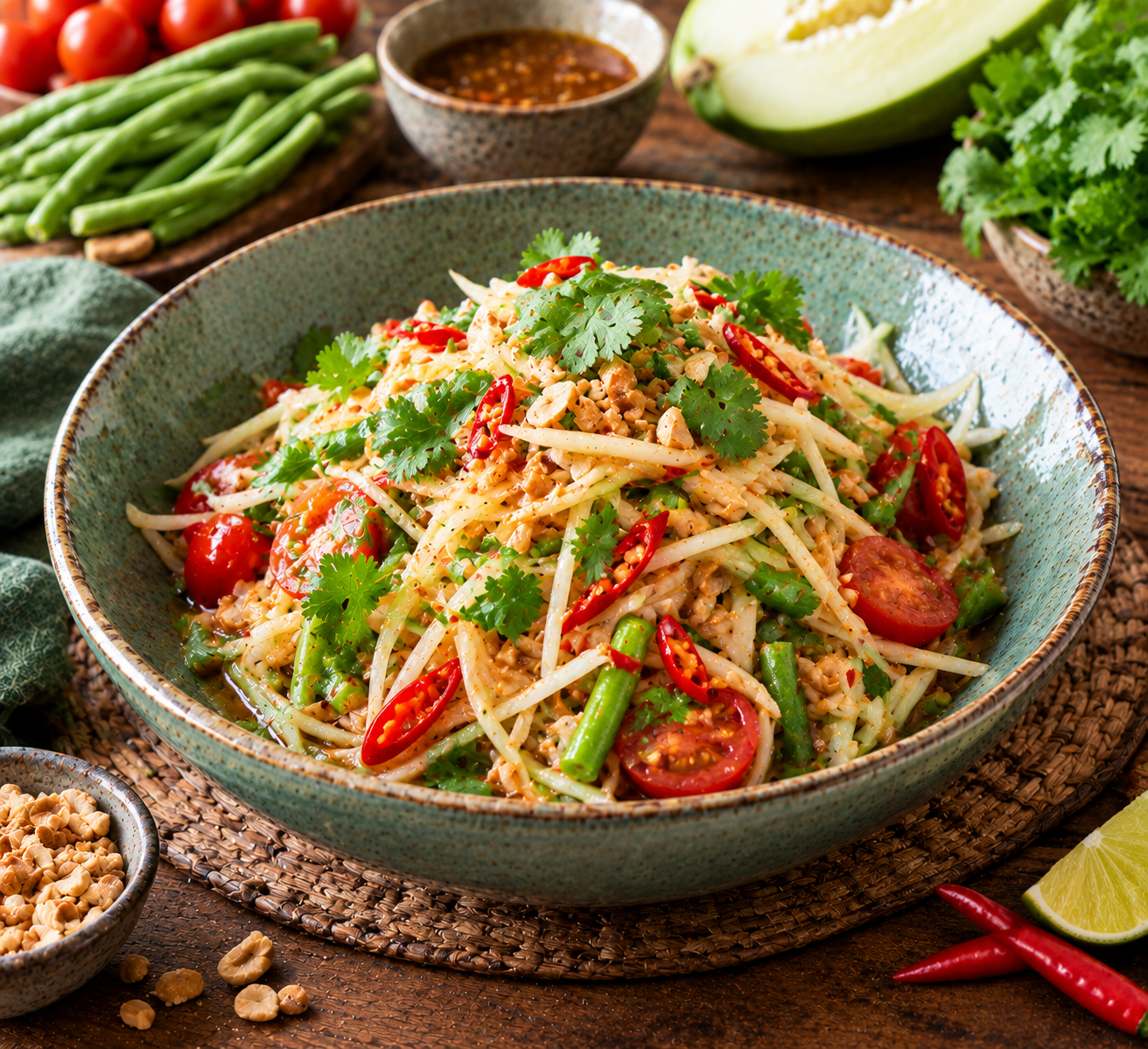
Crisp, refreshing and full of bold flavour, Som Tum is a much-loved salad from Thai cuisine. Made with shredded unripe green papaya, juicy cherry tomatoes, crunchy green beans and roasted peanuts, it brings together a delicious balance of spicy, sour, salty and sweet.
The dressing combines fresh lime juice, fish sauce, garlic, red chilli and palm sugar to create the distinctive flavour that makes this salad so memorable. A little tamarind paste adds extra tang, while fresh coriander provides a bright herbal finish.
Som Tum is best enjoyed freshly prepared, when the papaya is at its crunchiest and the dressing is at its most vibrant. Serve it as a refreshing side dish with grilled chicken, fish or sticky rice, or enjoy it as a light meal when you want something fresh and flavourful.
Peel the papaya, remove the seeds, and shred the flesh using a julienne peeler or grater.
For extra crunch, place the shredded papaya in cold water for a few minutes, then drain thoroughly and pat dry.
Prepare the dressing:
In a small bowl, combine the garlic, chillies, fish sauce, lime juice, palm sugar and tamarind paste, if using.
Stir until the sugar dissolves.
Taste and adjust the balance of sweet, sour, salty, and spicy flavours to your preference.
Combine the salad ingredients:
Place the shredded papaya, cherry tomatoes, and sliced green beans in a large bowl.
Add the dressing and toss gently until everything is evenly coated.
Mix and lightly bruise:
For a more traditional texture, gently pound the ingredients with a pestle in a large mortar, working in small batches if necessary.
Alternatively, lightly press the tomatoes and beans with the back of a spoon to release some of their juices.
Avoid crushing the papaya too much.
Add the finishing touches:
Transfer the salad to a serving dish and sprinkle with roasted peanuts and fresh coriander, if using.
Taste and serve:
Add extra lime juice for more tang, a little sugar for sweetness, or more chilli for heat.
Serve immediately while the papaya is crisp and fresh.
Papaya Salad is tangy, spicy, and refreshingly crunchy. 😊
It’s a refreshing, spicy, and tangy salad built on the crunch of unripe papaya, balanced with sweet palm sugar, sour lime, salty fish sauce, and fiery chili.
Why You’ll Love This Som Tum
Fresh and crunchy: Shredded green papaya gives the salad its distinctive crisp texture.
A balance of bold flavours: Lime, chilli, garlic, fish sauce and sugar create a lively dressing.
Quick and easy: This no-cook recipe comes together in about 15 minutes.
Perfect for sharing: Serve it alongside grilled dishes, rice or other Asian-inspired favourites.
Easy to customise: Adjust the chilli, sweetness and acidity to suit your taste.
Naturally refreshing: Its bright flavours make it especially enjoyable as part of a warm-weather meal.
Tips for the Best Som Tum
Choose firm green papaya: Use unripe papaya with pale, firm flesh. Ripe papaya is much softer and sweeter, so it will not provide the same traditional texture.
Shred the papaya evenly: Thin, even strips absorb the dressing well while retaining their crunch.
Drain the papaya thoroughly: Excess water can dilute the dressing and weaken the flavour.
Adjust the chilli carefully: Start with one chilli if you prefer a milder salad, then add more after tasting.
Dissolve the sugar: Stir the dressing until the sugar has dissolved so that sweetness is distributed evenly.
Balance the dressing: Aim for a combination of sour, salty, sweet and spicy flavours rather than allowing one ingredient to dominate.
Avoid over-pounding: Lightly bruising the vegetables releases flavour without turning the salad watery or mushy.
Add the peanuts just before serving: This helps preserve their roasted crunch.
Serve immediately: The papaya gradually softens as it sits in the dressing, so prepare the salad close to serving time.
Check the ingredients: Fish sauce and peanuts are important flavour components, but you can use suitable alternatives to accommodate dietary needs.
Storage and Reheating
Som Tum is best eaten immediately after preparation. The dressing draws moisture from the papaya and gradually softens the vegetables.
Best texture: Serve as soon as the salad has been tossed with the dressing.
Preparing ahead: Shred and drain the papaya, slice the vegetables and prepare the dressing separately. Store each component covered in the refrigerator and combine shortly before serving.
Leftovers: Place leftovers in a clean, covered container and refrigerate promptly. For best texture, eat within 24 hours.
Food safety: Do not leave the salad at room temperature for more than 2 hours, or more than 1 hour in temperatures above 32°C. Refrigerate sooner in hot weather.
Reheating: Som Tum is served cold or at room temperature and does not need reheating.
Freezing: Freezing is not recommended because the papaya and other vegetables lose their crisp texture after thawing.
If you have added cooked chicken, prawns or another protein, refrigerate promptly and follow the usual safe-storage guidance for those ingredients.
Here are some top pairings based on traditional Thai cuisine and modern fusion ideas:
🍚 Classic Thai Pairings
These are tried-and-true companions that enhance Som Tum’s flavor:
Sticky Rice – A chewy, neutral base that balances the salad’s heat and acidity.
Grilled Chicken Skewers (Gai Yang) – Smoky, savory, and juicy—perfect with the salad’s zing.
Thai Fish Cakes (Tod Mun Pla) – Aromatic and protein-rich, often served with sweet chili sauce.
Crispy Catfish Salad – Crunchy and zesty, it mirrors Som Tum’s texture while adding depth.
🥗 Fresh & Crunchy Sides
To amplify the salad’s brightness:
Spring Rolls (Fresh or Fried) – Filled with herbs and veggies, they add texture and variety.
Mango Salad – Sweet and juicy, it complements the spicy papaya beautifully.
Spicy Glass Noodle Salad – Tangy and chewy, with shrimp or tofu for added protein.
Shrimp Tempura or Grilled Prawns – Lightly crispy or smoky, they pair well with Som Tum’s acidity.
🥥 Rice & Noodle Options
To round out the meal:
Coconut Rice – Creamy and fragrant, it softens the salad’s spice.
Thai Noodle Soup – Warm and comforting, it balances the salad’s crispness.
Here are some fun variations to experiment with for your Papaya Salad recipe:
Variations
🥭 Tropical Fruit Fusion
Add juicy sweetness and color:
Swap or mix green papaya with shredded mango, pineapple, or green apple.
Add passion fruit pulp or grapefruit segments for a tart punch.
Garnish with mint leaves and toasted coconut flakes.
🥩 Protein Boost
Make it a satisfying main:
Add grilled shrimp, chicken strips, or crispy tofu.
Top with a soft-boiled egg or tempeh slices.
Serve over a bed of rice noodles or jasmine rice.
🌶️ Extra Heat Lovers
Turn up the spice:
Use bird’s eye chilies, chili flakes, or fermented chili paste.
Add a drizzle of chili oil or sriracha before serving.
Garnish with pickled red chilies or spicy roasted peanuts.
🥒 Pickled & Fermented
Add bold, tangy layers:
Mix in pickled carrots, radish, or green mango.
Stir a spoonful of kimchi juice or fermented bean paste into the dressing.
Garnish with pickled onions and fresh herbs.
🧄 Umami Depth
Enhance savory complexity:
Add dried shrimp, grilled mushrooms, or crispy shallots.
Use miso paste or soy glaze in the dressing.
Top with black sesame seeds and fried garlic chips.
🍜 Noodle Bowl Remix
Transform it into a slaw-meets-noodle dish:
Toss with rice noodles, glass noodles, or shredded cabbage.
Add julienned carrots, cucumber, and bean sprouts.
Serve chilled with lime wedges and extra peanuts.
Final Thoughts
Som Tum is a bright, crunchy salad that brings together the bold flavours of lime, chilli, garlic, fish sauce and a touch of sweetness. Its fresh ingredients and lively dressing make it a wonderful companion to grilled dishes, rice and other Asian-inspired meals.
The secret to a delicious papaya salad is balancing the dressing to your taste and keeping the vegetables crisp. Prepare it just before serving, finish with roasted peanuts and fresh coriander, and enjoy a refreshing dish full of flavour.
Frequently Asked Questions
What is Som Tum?
Som Tum, also written as Som Tam, is a spicy green papaya salad associated with Thai cuisine. Related papaya salads are also popular in Laos and other parts of Southeast Asia. The ingredients and dressing vary by region and personal preference.
Can I make Som Tum without green papaya?
Yes. Shredded unripe green mango, green apple or cucumber can provide a crisp alternative. The flavour and texture will differ from the traditional version.
Is Som Tum very spicy?
It can be, but you control the heat. Start with one mild red chilli, taste the dressing and add more gradually. You can also serve extra chilli separately.
Can I make Som Tum without fish sauce?
Yes. Use soy sauce or a vegan fish sauce alternative. Soy sauce provides saltiness but has a different flavour, so taste the dressing and adjust the lime and sugar as needed.
Do I need a mortar and pestle?
No. A large bowl and spoon are sufficient. A mortar and pestle can help release flavour from the garlic, chilli and vegetables, but gentle mixing also produces a delicious salad.
Can I prepare Som Tum in advance?
You can prepare the individual components ahead of time, but keep the dressing separate from the shredded papaya and vegetables. Toss everything together shortly before serving to retain the best crunch.
Is Som Tum suitable for a vegan diet?
It can be. Replace the fish sauce with a suitable vegan alternative or soy sauce, and check that all other ingredients meet your dietary requirements. Traditional versions may contain fish-based seasonings.
Can I use ripe papaya?
Ripe papaya is softer and sweeter than green papaya, so it will not give the salad its traditional crisp texture. For the best result, choose firm, unripe green papaya.
Essential cookies enable basic functions and are necessary for the proper function of the website.
Name
Description
Duration
Cookie Preferences
This cookie is used to store the user's cookie consent preferences.
30 days
These cookies are needed for adding comments on this website.
Name
Description
Duration
comment_author
Used to track the user across multiple sessions.
Session
comment_author_email
Used to track the user across multiple sessions.
Session
comment_author_url
Used to track the user across multiple sessions.
Session
Google's current Sign in with Google client library. It renders the Google sign-in button, or the One Tap prompt, so visitors can log in to your site with their Google account. It replaces the older Google Sign-In platform library.
Set on your own domain by the Sign in with Google client library. Records whether the visitor has dismissed the One Tap sign-in prompt and for how long it should stay hidden, plus the time the library last loaded and a browsing session id used for the same purpose. Sites that pass a custom state_cookie_name will see that name instead.
180 days
g_csrf_token
Set on your own domain by the Sign in with Google client library and submitted together with the sign-in credential, so your site can confirm the sign-in came from its own page and not from a forged cross-site request.
5 minutes
Statistics cookies collect information anonymously. This information helps us understand how visitors use our website.
Google Analytics is a powerful tool that tracks and analyzes website traffic for informed marketing decisions.
Contains information related to marketing campaigns of the user. These are shared with Google AdWords / Google Ads when the Google Ads and Google Analytics accounts are linked together.
90 days
__utma
ID used to identify users and sessions
2 years after last activity
__utmt
Used to monitor number of Google Analytics server requests
10 minutes
__utmb
Used to distinguish new sessions and visits. This cookie is set when the GA.js javascript library is loaded and there is no existing __utmb cookie. The cookie is updated every time data is sent to the Google Analytics server.
30 minutes after last activity
__utmc
Used only with old Urchin versions of Google Analytics and not with GA.js. Was used to distinguish between new sessions and visits at the end of a session.
End of session (browser)
__utmz
Contains information about the traffic source or campaign that directed user to the website. The cookie is set when the GA.js javascript is loaded and updated when data is sent to the Google Anaytics server
6 months after last activity
__utmv
Contains custom information set by the web developer via the _setCustomVar method in Google Analytics. This cookie is updated every time new data is sent to the Google Analytics server.
2 years after last activity
__utmx
Used to determine whether a user is included in an A / B or Multivariate test.
18 months
_ga
ID used to identify users
2 years
_gali
Used by Google Analytics to determine which links on a page are being clicked
30 seconds
_ga_
ID used to identify users
2 years
_gid
ID used to identify users for 24 hours after last activity
24 hours
_gat
Used to monitor number of Google Analytics server requests when using Google Tag Manager
1 minute
Marketing cookies are used to follow visitors to websites. The intention is to show ads that are relevant and engaging to the individual user.
Google Ads is an online advertising platform that enables businesses to create targeted ads displayed on Google search results and partner sites.
Targeting cookie. Used to create a user profile and display relevant and personalised Google Ads to the user.
2 years
__Secure-1PSIDCC
Targeting cookie. Used to create a user profile and display relevant and personalised Google Ads to the user.
2 years
__Secure-3PAPISID
Profiles the interests of website visitors to serve relevant and personalised ads through retargeting.
2 years
AEC
AEC cookies ensure that requests within a browsing session are made by the user, and not by other sites. These cookies prevent malicious sites from acting on behalf of a user without that user's knowledge.
6 months
ADS_VISITOR_ID
Cookie required to use the options and on-site web services
2 months
__Secure-3PSIDCC
Targeting cookie. Used to create a user profile and display relevant and personalised Google Ads to the user.
2 years
__Secure-3PSIDTS
Targeting cookie. Used to create a user profile and display relevant and personalised Google Ads to the user.
2 years
__Secure-1PSIDTS
Targeting cookie. Used to create a user profile and display relevant and personalised Google Ads to the user.
2 years
__Secure-1PAPISID
Targeting cookie. Used to create a user profile and display relevant and personalised Google Ads to the user.
2 years
__Secure-3PSID
Targeting cookie. Used to profile the interests of website visitors and display relevant and personalised Google ads.
2 years
Conversion
Google uses cookies for advertising, including serving and rendering ads, personalizing ads (depending on your ad settings at g.co/adsettings), limiting the number of times an ad is shown to a user, muting ads you have chosen to stop seeing, and measuring the effectiveness of ads.
90 days
_gcl_aw
Google uses cookies for advertising, including serving and rendering ads, personalizing ads (depending on your ad settings at g.co/adsettings), limiting the number of times an ad is shown to a user, muting ads you have chosen to stop seeing, and measuring the effectiveness of ads.
90 Days
_gcl_gs
Google uses cookies for advertising, including serving and rendering ads, personalizing ads (depending on your ad settings at g.co/adsettings), limiting the number of times an ad is shown to a user, muting ads you have chosen to stop seeing, and measuring the effectiveness of ads.
90 Days
_gcl_gb
Google uses cookies for advertising, including serving and rendering ads, personalizing ads (depending on your ad settings at g.co/adsettings), limiting the number of times an ad is shown to a user, muting ads you have chosen to stop seeing, and measuring the effectiveness of ads.
90 Days
_gac_gb_
Google uses cookies for advertising, including serving and rendering ads, personalizing ads (depending on your ad settings at g.co/adsettings), limiting the number of times an ad is shown to a user, muting ads you have chosen to stop seeing, and measuring the effectiveness of ads.
90 Days
FPGCLGB
Google uses cookies for advertising, including serving and rendering ads, personalizing ads (depending on your ad settings at g.co/adsettings), limiting the number of times an ad is shown to a user, muting ads you have chosen to stop seeing, and measuring the effectiveness of ads.
90 Days
FPGCLAW
Google uses cookies for advertising, including serving and rendering ads, personalizing ads (depending on your ad settings at g.co/adsettings), limiting the number of times an ad is shown to a user, muting ads you have chosen to stop seeing, and measuring the effectiveness of ads.
90 Days
You can find more information in our Cookie Policy and .