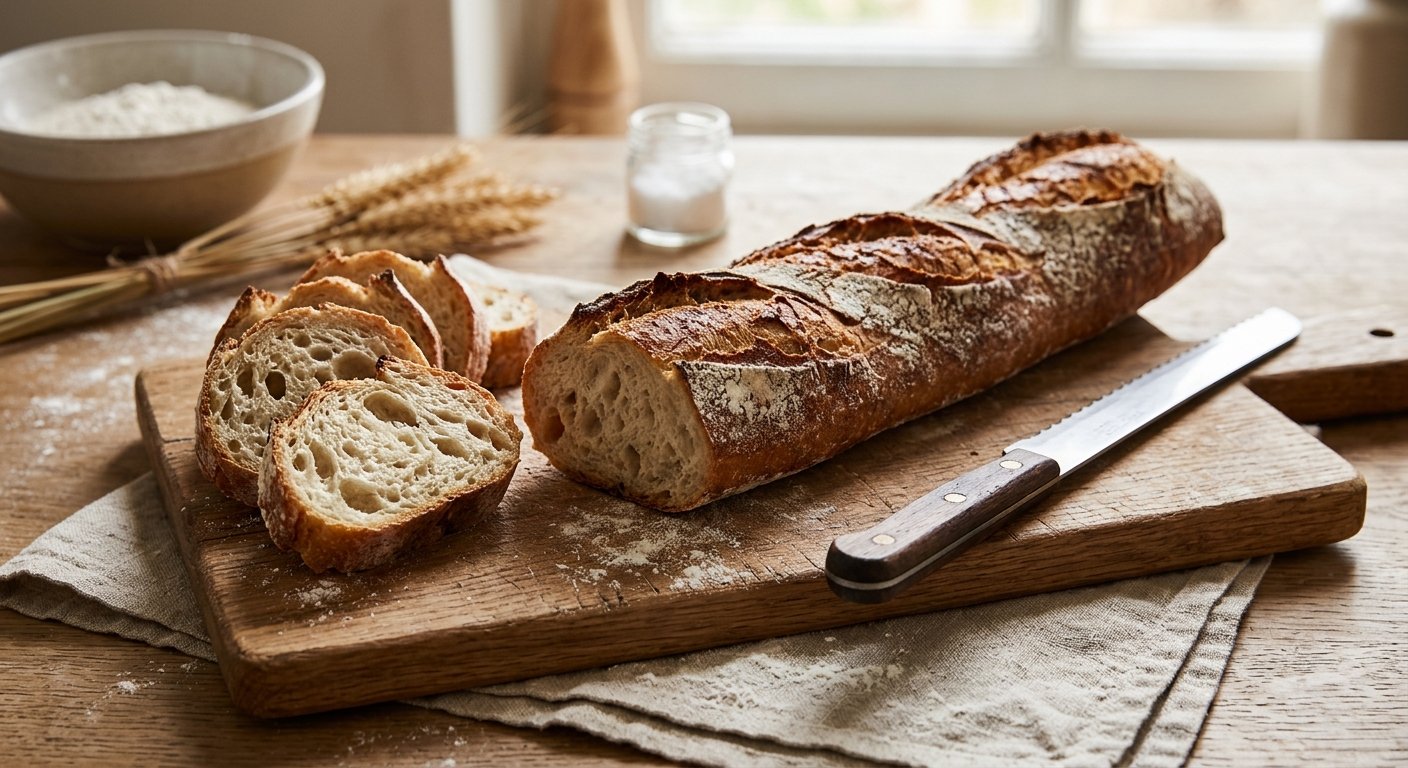
Bring the charm of a French bakery into your kitchen with this homemade crusty baguette recipe. Made with simple ingredients such as bread flour, yeast, salt and water, these traditional-style loaves develop a beautifully golden crust and a soft, airy interior. They are perfect for serving warm with butter, making sandwiches or enjoying alongside your favourite soups and stews.
The secret to a good baguette lies in the dough, proper rising time and a hot oven. Kneading develops the gluten that gives the bread its characteristic chewy texture, while a second rise allows the shaped loaves to become light and airy. Steam in the oven helps the crust develop before it turns crisp and golden.
Although baguettes require a little patience, the method is straightforward and does not require specialist equipment. With a sharp knife for scoring and a baking tray, you can create delicious homemade bread for everyday meals and special occasions.
A pinch of sugar (to help activate yeast), optional
A little extra flour or cornmeal for dusting (optional)
Method:
Combine the ingredients:
Place the bread flour, salt, and instant yeast in a large mixing bowl.
Keep the salt and yeast separated initially when adding them to the flour, then mix everything together.
Gradually pour in the lukewarm water, stirring until a rough, slightly sticky dough forms.
The optional sugar can be added with the dry ingredients, although it is not necessary when using instant yeast.
Knead the dough:
Transfer the dough to a lightly floured work surface.
Knead for approximately 8–10 minutes until it becomes smooth, elastic, and slightly tacky.
Alternatively, use a stand mixer fitted with a dough hook.
Avoid adding too much extra flour, as a dough that is too dry can produce a dense baguette.
Allow the first rise:
Place the dough in a lightly greased bowl and cover with a clean, damp tea towel or reusable cover.
Leave it in a warm, draught-free place for 1–1½ hours, or until it has approximately doubled in size.
Divide and shape the dough:
Gently turn the risen dough onto a lightly floured surface and divide it into two or three equal portions.
Shape each portion into a rough rectangle, fold the long edges towards the centre and press to seal.
Roll each piece gently from the centre outwards until it forms a long, evenly shaped loaf with tapered ends.
Prepare for the second rise:
Place the shaped baguettes on a baking tray lined with baking paper and lightly dusted with flour or cornmeal.
Leave space between the loaves.
Cover loosely and allow them to rise for another 30–45 minutes, until slightly puffy.
Preheat the oven:
Towards the end of the second rise, preheat the oven to 230°C.
Place an empty, sturdy metal roasting tray on a lower rack if you plan to create steam.
Do not use a glass dish or pour water into a glass container that is not designed for high-temperature use.
Score the baguettes:
Just before baking, use a sharp bread lame or a very sharp knife to make three or four shallow diagonal cuts along the top of each loaf.
These slashes allow the bread to expand in the oven and create the baguette’s characteristic appearance.
Create steam and bake:
Place the baking tray in the oven.
Carefully pour a small amount of boiling water into the preheated metal tray on the lower rack to create steam, keeping your face and hands away from the escaping steam.
Close the oven door promptly and bake for 20–25 minutes, until the baguettes are golden brown and sound hollow when tapped on the underside.
If you prefer a particularly crisp crust, bake for a few extra minutes while watching the colour.
Cool before slicing:
Transfer the baguettes to a wire rack and allow them to cool for at least 20–30 minutes before slicing.
This allows the crumb to finish setting and helps prevent a gummy interior.
Why You’ll Love This Recipe
Crispy, golden crust: A hot oven and steam help create the classic crusty exterior.
Soft, chewy interior: Bread flour and proper kneading develop the structure needed for an airy crumb.
Simple ingredients: You only need a few everyday baking staples.
Versatile for any meal: Enjoy the baguettes with breakfast, lunch, dinner or a snack.
Perfect for sharing: Homemade baguettes are ideal for family meals, picnics and entertaining.
Customisable: Experiment with herbs, seeds, roasted garlic or cheese to create your own variation.
A Little About French Baguettes
The baguette is one of France’s best-known breads, recognised by its long, narrow shape, crisp crust and chewy interior. Its simplicity is part of its appeal: flour, water, yeast and salt can produce a remarkable loaf when the dough is handled carefully and given enough time to rise.
Two important techniques make a difference at home. First, kneading develops gluten, which helps the dough hold its shape and trap the gas produced by the yeast. Second, steam during the early stage of baking delays crust formation briefly, allowing the loaves to expand before the outside becomes firm.
A home oven may not produce the same results as a professional bakery oven, but these techniques will help you achieve delicious, crusty baguettes without expensive equipment.
Tips for the Best Crusty Baguettes
Use bread flour: Bread flour generally contains more protein than ordinary cake flour, helping develop the gluten structure needed for a chewy loaf.
Measure accurately: Weighing the flour and water gives more consistent results than using cups, which can vary depending on how the flour is packed.
Use lukewarm water: Water that is comfortably warm to the touch is suitable. Very hot water can damage the yeast and interfere with rising.
Knead until elastic: The dough should become smoother and stretch more easily as the gluten develops. If it feels sticky, give it a little more kneading before adding extra flour.
Watch the dough rather than the clock: Rising times depend on room temperature and yeast activity. Look for a noticeable increase in volume instead of relying entirely on the stated time.
Shape firmly but gently: Seal the folded dough along its length so the baguettes hold their shape. Roll evenly to avoid very thick centres and thin ends.
Allow the second rise: The final proof gives the shaped loaves time to become lighter. Under-proofed dough may split unpredictably, while over-proofed dough may collapse when scored.
Score just before baking: Use a sharp blade and make confident, shallow diagonal cuts. Avoid pressing down heavily and deflating the dough.
Create steam safely: Steam helps the crust develop, but boiling water and hot steam can cause burns. Pour carefully into a suitable metal tray, and keep your hands and face away from the oven opening.
Cool on a wire rack: Allow air to circulate around the bread as it cools. Placing hot baguettes directly on a solid surface can trap moisture underneath and soften the crust.
Avoid cutting too early: Slicing while the bread is very hot can make the interior seem gummy. Give the crumb time to set before cutting.
Bake until deeply golden: A pale loaf may have a softer crust. Look for an even golden-brown colour and a firm exterior before removing the baguettes from the oven.
Uses for This Recipe
Homemade baguettes are wonderfully versatile and can be used in countless sweet and savoury dishes.
Fresh sandwiches: Slice lengthwise and fill with cheese, chicken, roast vegetables, lettuce or your favourite spreads.
Garlic bread: Cut the baguette into slices and spread with garlic butter and herbs. Bake until fragrant and lightly crisp.
Bruschetta: Toast slices and top with chopped tomatoes, basil, garlic and olive oil for an easy appetiser.
Soup dipping bread: Serve warm slices alongside tomato soup, chicken soup or a hearty vegetable stew.
Breakfast toast: Pair slices with scrambled eggs, avocado, butter, honey or jam.
Croutons: Cut day-old baguette into cubes, toss with olive oil and seasoning, then bake until crisp for salads and soups.
French toast: Use slightly stale slices to make a custardy breakfast treat. Allow the bread to soak briefly in beaten egg and milk before frying.
Party canapés: Slice into small rounds and top with cheese, pesto, roasted vegetables or other favourite toppings.
Breadcrumbs: Dry leftover bread thoroughly and process it into breadcrumbs for coating vegetables or adding texture to baked dishes.
Cheese boards: Serve slices with cheeses, olives, spreads and fruit for a simple sharing platter.
Storage and Reheating
Fresh baguettes are at their best on the day they are baked, when the crust is crisp and the interior is soft. Here is how to store and refresh them.
Room temperature: Once completely cool, store the baguette in a paper bag or bread box for up to 1–2 days. A sealed plastic bag keeps the interior softer but also softens the crust.
Re-crisping: Lightly mist the crust with water and place the baguette in a preheated oven at 180°C for approximately 5–8 minutes. Allow it to cool briefly before serving.
Freezing: Freeze a completely cooled baguette, whole or sliced, in a freezer-safe bag for up to 2–3 months for the best quality. Remove as much air as possible before sealing.
Reheating from frozen: Place a whole frozen baguette in a 180°C oven for approximately 10–15 minutes, checking that it is heated through. Slices can be toasted directly from frozen.
Using stale bread: If the baguette becomes firm, turn it into croutons, breadcrumbs, garlic bread or French toast rather than throwing it away.
Avoid refrigerating baguettes, as refrigeration can cause bread to stale more quickly.
What to Serve with Crusty Baguettes
The crisp crust and chewy centre make baguettes an excellent accompaniment to many meals, from light lunches to rich, comforting dinners.
Soups and Stews
French onion soup: Toasted baguette slices topped with melted cheese are a classic pairing.
Potato and leek soup: The soft, savoury soup contrasts beautifully with the crunchy crust.
Vegetable soup: Serve thick slices alongside a bowl of hearty homemade soup.
Beef stew: Use the bread to soak up the rich gravy.
Beef bourguignon: A crusty baguette is ideal for enjoying the sauce in this traditional French-inspired dish.
Cheese and Spreads
Brie and fig jam: Creamy cheese and sweet fig jam create an elegant appetiser.
Goat cheese and fresh herbs: Spread onto toasted baguette rounds and finish with olive oil.
Basil pesto: Its fresh, aromatic flavour complements the bread.
Garlic aioli: A creamy garlic spread makes a delicious dip.
Hummus: Serve with hummus and fresh vegetables for a simple snack.
Olive tapenade: A savoury olive spread pairs beautifully with the baguette’s chewy texture.
Main Meals and Sandwiches
Roast chicken: Serve slices alongside roast chicken and vegetables.
Grilled steak: Use the bread to enjoy the pan juices or serve it as part of a steak sandwich.
Bánh mì-inspired sandwiches: Fill with cooked meat or tofu, pickled vegetables, fresh coriander and a savoury sauce.
Roasted vegetable sandwiches: Layer grilled vegetables, pesto and cheese inside a sliced baguette.
Pasta dishes: Serve warm bread with tomato-based pasta, creamy sauces or baked pasta.
Salads: Pair with a fresh green salad, tomato salad or a Mediterranean grain salad for a lighter meal.
Breakfast and Brunch
Scrambled eggs: Serve warm baguette slices with soft, fluffy eggs.
Avocado toast: Top toasted slices with mashed avocado, lemon and black pepper.
Jam and butter: Enjoy a simple breakfast with butter, honey or your favourite jam.
Eggs Benedict-inspired baguette: Use toasted slices as a base for poached eggs and hollandaise sauce.
Here are some fun variations to experiment with for your Crusty Baguette recipe:
Variations
🧄 Savory Add-Ins
Roasted Garlic Baguette: Fold in roasted garlic cloves during shaping for a mellow, aromatic flavor.
Herb-Infused Dough: Add 1–2 tsp of dried herbs like rosemary, thyme, or oregano to the flour mix.
Cheese Burst: Sprinkle shredded Gruyère, cheddar, or Parmesan inside the dough before rolling for gooey pockets.
🍯 Sweet Twists
Honey Wheat Baguette: Replace 50g of bread flour with whole wheat flour and add 1 tbsp honey for a subtly sweet, nutty loaf.
Cinnamon Raisin: Mix in 1 tsp cinnamon and ½ cup raisins during kneading for a breakfast-style baguette.
Orange Zest & Cranberry: Add 1 tbsp orange zest and ½ cup dried cranberries for a festive flavor.
🌾 Texture & Crust Enhancers
Seeded Crust: Roll shaped baguettes in sesame, poppy, or flax seeds before the second rise.
Olive Oil Glaze: Brush with olive oil before baking for a richer crust and golden sheen.
Multigrain Boost: Swap 100g of bread flour with oats, millet, or rye for a hearty texture.
🌶️ Bold Flavor Profiles
Spicy Jalapeño & Cheese: Add chopped jalapeños and shredded cheese for a fiery kick.
Sun-Dried Tomato & Basil: Mix in chopped sun-dried tomatoes and fresh basil for a Mediterranean vibe.
Caramelized Onion: Fold in caramelized onions for a sweet-savory depth.
🥖 Shape Experiments
Mini Baguette Rolls: Divide dough into 6–8 small pieces for individual sandwich rolls.
Twisted Baguettes: Twist two strands of dough together for a braided look and extra crust.
Stuffed Baguette Logs: Roll dough around fillings like pesto, tapenade, or cream cheese before baking.
Final Thoughts
Homemade crusty baguettes bring the simple pleasure of freshly baked bread into your kitchen. With a golden, crackling crust and a soft, chewy centre, they are perfect for sandwiches, soup dipping, cheese boards and countless other meals.
Although the dough needs time to rise, the ingredients and techniques are straightforward. Take care with kneading, shaping and baking, and you will be rewarded with rustic loaves that taste wonderful straight from the oven. Once you have mastered this basic recipe, experiment with herbs, seeds, cheese or olives to make each batch your own.
Frequently Asked Questions
Why is my baguette crust not crispy?
A soft crust can result from insufficient baking, inadequate steam during the early baking stage or storing the bread while it is still warm. Bake until deeply golden, cool on a wire rack and re-crisp in the oven if necessary.
Why is my baguette dense?
Dense bread can result from insufficient kneading, inactive yeast, inadequate rising time or too much extra flour. Make sure the yeast is within its use-by date, knead until the dough is elastic and allow it to rise until visibly expanded.
Can I use plain flour instead of bread flour?
Yes. Plain flour can be used if bread flour is unavailable, but the baguettes may have a slightly softer crumb and less chew. Add the water gradually, as different flours absorb different amounts of liquid.
Do I need sugar to activate the yeast?
No. Instant yeast does not require added sugar to work in this recipe. A pinch of sugar is optional, and the yeast can be mixed directly with the flour.
Can I make baguette dough ahead of time?
Yes. After mixing and kneading, cover the dough and refrigerate it for a slow rise overnight. The next day, allow it to lose some of its chill, then shape, proof and bake. The dough may need additional time to rise, depending on its temperature.
Why did my baguette split along the side?
This can happen if the loaf was not scored deeply enough, was under-proofed, or expanded unevenly in the oven. Make three or four confident diagonal slashes just before baking and allow the shaped dough to become slightly puffy before it goes into the oven.
How do I know when the baguette is fully baked?
The crust should be golden brown and firm, and the loaf should sound hollow when tapped on the underside. If you use a thermometer, the centre of a lean loaf is generally around 95–99°C when fully baked.
Can I bake baguettes without a special baguette tray?
Absolutely. A standard baking tray lined with baking paper works well. Arrange the loaves with enough space between them and, if needed, use folded baking paper or a clean kitchen towel during the second rise to help support their shape. Remove any towel before baking.
Can I make this recipe without creating steam?
Yes. The baguettes will still bake, but the crust may be slightly different. Steam is helpful rather than essential. If you use it, choose a suitable metal tray and handle the hot water carefully.
Can I freeze homemade baguettes?
Yes. Freeze them once completely cool, either whole or sliced, in a freezer-safe bag. Reheat in the oven to refresh the crust and texture.
Essential cookies enable basic functions and are necessary for the proper function of the website.
Name
Description
Duration
Cookie Preferences
This cookie is used to store the user's cookie consent preferences.
30 days
These cookies are needed for adding comments on this website.
Name
Description
Duration
comment_author
Used to track the user across multiple sessions.
Session
comment_author_email
Used to track the user across multiple sessions.
Session
comment_author_url
Used to track the user across multiple sessions.
Session
Google's current Sign in with Google client library. It renders the Google sign-in button, or the One Tap prompt, so visitors can log in to your site with their Google account. It replaces the older Google Sign-In platform library.
Set on your own domain by the Sign in with Google client library. Records whether the visitor has dismissed the One Tap sign-in prompt and for how long it should stay hidden, plus the time the library last loaded and a browsing session id used for the same purpose. Sites that pass a custom state_cookie_name will see that name instead.
180 days
g_csrf_token
Set on your own domain by the Sign in with Google client library and submitted together with the sign-in credential, so your site can confirm the sign-in came from its own page and not from a forged cross-site request.
5 minutes
Statistics cookies collect information anonymously. This information helps us understand how visitors use our website.
Google Analytics is a powerful tool that tracks and analyzes website traffic for informed marketing decisions.
Contains information related to marketing campaigns of the user. These are shared with Google AdWords / Google Ads when the Google Ads and Google Analytics accounts are linked together.
90 days
__utma
ID used to identify users and sessions
2 years after last activity
__utmt
Used to monitor number of Google Analytics server requests
10 minutes
__utmb
Used to distinguish new sessions and visits. This cookie is set when the GA.js javascript library is loaded and there is no existing __utmb cookie. The cookie is updated every time data is sent to the Google Analytics server.
30 minutes after last activity
__utmc
Used only with old Urchin versions of Google Analytics and not with GA.js. Was used to distinguish between new sessions and visits at the end of a session.
End of session (browser)
__utmz
Contains information about the traffic source or campaign that directed user to the website. The cookie is set when the GA.js javascript is loaded and updated when data is sent to the Google Anaytics server
6 months after last activity
__utmv
Contains custom information set by the web developer via the _setCustomVar method in Google Analytics. This cookie is updated every time new data is sent to the Google Analytics server.
2 years after last activity
__utmx
Used to determine whether a user is included in an A / B or Multivariate test.
18 months
_ga
ID used to identify users
2 years
_gali
Used by Google Analytics to determine which links on a page are being clicked
30 seconds
_ga_
ID used to identify users
2 years
_gid
ID used to identify users for 24 hours after last activity
24 hours
_gat
Used to monitor number of Google Analytics server requests when using Google Tag Manager
1 minute
Marketing cookies are used to follow visitors to websites. The intention is to show ads that are relevant and engaging to the individual user.
Google Ads is an online advertising platform that enables businesses to create targeted ads displayed on Google search results and partner sites.
Targeting cookie. Used to create a user profile and display relevant and personalised Google Ads to the user.
2 years
__Secure-1PSIDCC
Targeting cookie. Used to create a user profile and display relevant and personalised Google Ads to the user.
2 years
__Secure-3PAPISID
Profiles the interests of website visitors to serve relevant and personalised ads through retargeting.
2 years
AEC
AEC cookies ensure that requests within a browsing session are made by the user, and not by other sites. These cookies prevent malicious sites from acting on behalf of a user without that user's knowledge.
6 months
ADS_VISITOR_ID
Cookie required to use the options and on-site web services
2 months
__Secure-3PSIDCC
Targeting cookie. Used to create a user profile and display relevant and personalised Google Ads to the user.
2 years
__Secure-3PSIDTS
Targeting cookie. Used to create a user profile and display relevant and personalised Google Ads to the user.
2 years
__Secure-1PSIDTS
Targeting cookie. Used to create a user profile and display relevant and personalised Google Ads to the user.
2 years
__Secure-1PAPISID
Targeting cookie. Used to create a user profile and display relevant and personalised Google Ads to the user.
2 years
__Secure-3PSID
Targeting cookie. Used to profile the interests of website visitors and display relevant and personalised Google ads.
2 years
Conversion
Google uses cookies for advertising, including serving and rendering ads, personalizing ads (depending on your ad settings at g.co/adsettings), limiting the number of times an ad is shown to a user, muting ads you have chosen to stop seeing, and measuring the effectiveness of ads.
90 days
_gcl_aw
Google uses cookies for advertising, including serving and rendering ads, personalizing ads (depending on your ad settings at g.co/adsettings), limiting the number of times an ad is shown to a user, muting ads you have chosen to stop seeing, and measuring the effectiveness of ads.
90 Days
_gcl_gs
Google uses cookies for advertising, including serving and rendering ads, personalizing ads (depending on your ad settings at g.co/adsettings), limiting the number of times an ad is shown to a user, muting ads you have chosen to stop seeing, and measuring the effectiveness of ads.
90 Days
_gcl_gb
Google uses cookies for advertising, including serving and rendering ads, personalizing ads (depending on your ad settings at g.co/adsettings), limiting the number of times an ad is shown to a user, muting ads you have chosen to stop seeing, and measuring the effectiveness of ads.
90 Days
_gac_gb_
Google uses cookies for advertising, including serving and rendering ads, personalizing ads (depending on your ad settings at g.co/adsettings), limiting the number of times an ad is shown to a user, muting ads you have chosen to stop seeing, and measuring the effectiveness of ads.
90 Days
FPGCLGB
Google uses cookies for advertising, including serving and rendering ads, personalizing ads (depending on your ad settings at g.co/adsettings), limiting the number of times an ad is shown to a user, muting ads you have chosen to stop seeing, and measuring the effectiveness of ads.
90 Days
FPGCLAW
Google uses cookies for advertising, including serving and rendering ads, personalizing ads (depending on your ad settings at g.co/adsettings), limiting the number of times an ad is shown to a user, muting ads you have chosen to stop seeing, and measuring the effectiveness of ads.
90 Days
You can find more information in our Cookie Policy and .