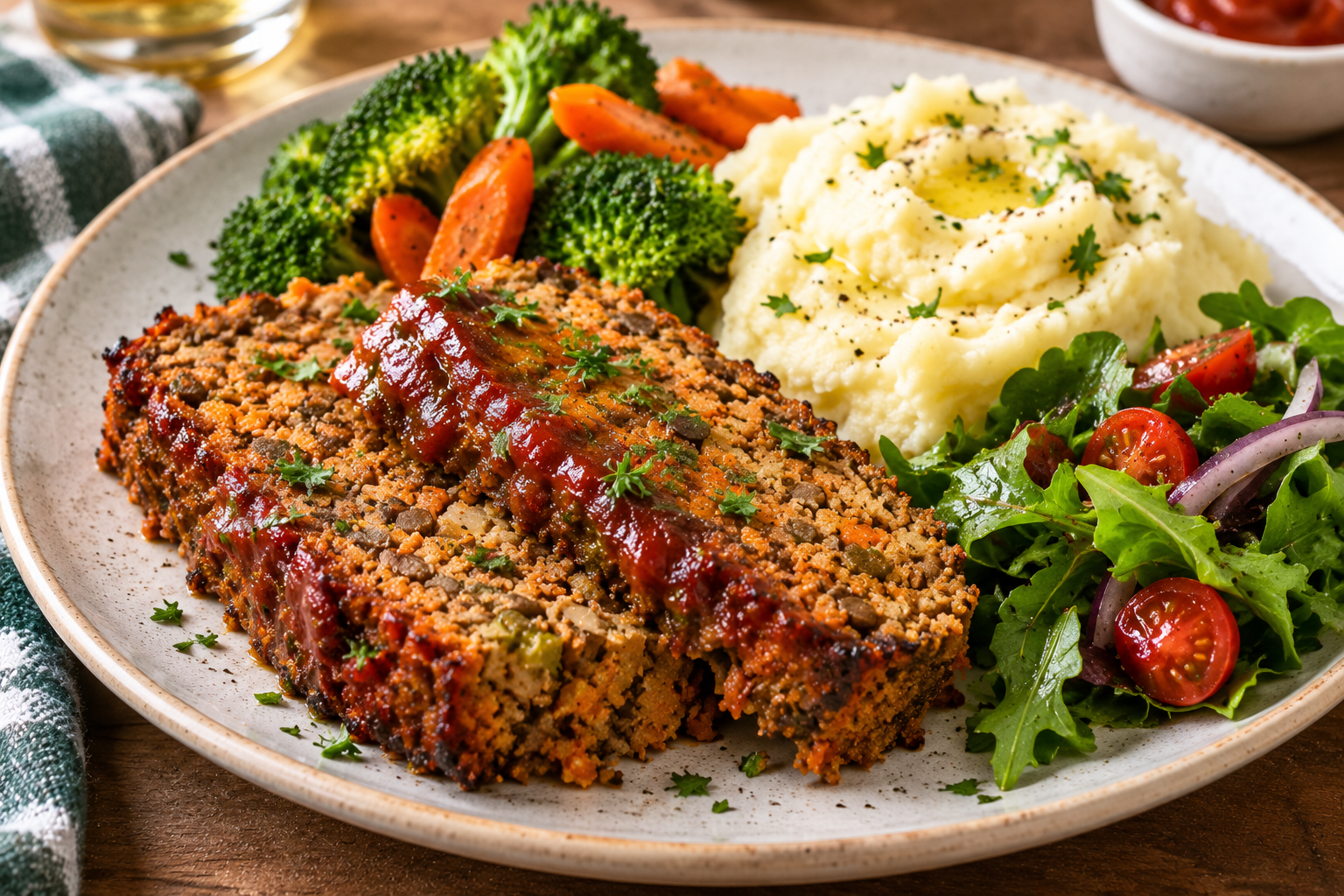
Lentil loaf is a delicious plant-based alternative to traditional meatloaf, offering a satisfying texture and rich, savoury flavour in every slice. Made with cooked lentils, sautéed vegetables, breadcrumbs and warming spices, this wholesome dish is perfect for family dinners, Sunday lunches or a special vegetarian meal.
The mixture combines earthy lentils with onion, garlic, carrots and celery, while smoked paprika, thyme and cumin add depth. A sweet and tangy glaze made with ketchup, brown sugar and Dijon mustard creates a beautifully flavoured topping that becomes lightly caramelised as the loaf bakes.
Serve this lentil loaf with creamy mashed potatoes, roasted vegetables or a fresh salad for a comforting meal. With an easy vegan option and plenty of ways to customise the flavour, it is a versatile recipe worth adding to your regular meal rotation.
Lightly grease a standard loaf pan or line it with baking paper, leaving a little overhang to help lift the loaf out later.
Sauté the vegetables:
Heat the olive oil in a skillet over medium heat.
Add the onion, garlic, grated carrots, and celery.
Cook for 5–7 minutes, stirring occasionally, until the vegetables have softened.
Remove from the heat and allow them to cool slightly.
Prepare the lentil mixture:
Place the cooked lentils in a large mixing bowl.
Mash them lightly with a fork or potato masher, leaving some whole lentils for texture.
Add the breadcrumbs, sautéed vegetables, tomato paste, soy sauce, smoked paprika, thyme, cumin, black pepper and salt.
Add the binder:
Mix in the eggs until the ingredients are evenly combined.
For a vegan loaf, use flax eggs instead.
The mixture should hold together when pressed.
If it feels too wet, add a little more breadcrumbs; if it seems dry, mix in a small splash of water or vegetable stock.
Shape the loaf:
Transfer the mixture to the prepared loaf pan.
Press it down firmly and smooth the surface so the loaf holds its shape after baking.
Make the glaze:
In a small bowl, stir together the ketchup, brown sugar, and Dijon mustard until smooth.
Spread the glaze evenly over the top of the lentil mixture.
Bake until firm:
Bake for approximately 45 minutes, or until the loaf is set and the glaze has thickened.
If the top starts browning too quickly, cover it loosely with foil for the remaining baking time.
Rest before slicing:
Remove the loaf from the oven and leave it to rest in the pan for 10–15 minutes.
This helps it firm up and makes slicing easier.
Carefully lift it out, slice and serve warm.
A plant-based alternative to meatloaf that’s packed with flavor and texture. 😊
It’s a hearty, plant-forward alternative to meatloaf—nutritious, flavorful, and versatile.
🌟 Key Highlights
Lentils: Protein-rich, fiber-packed, and provide a satisfying texture.
Breadcrumbs or oats: Help bind the loaf and add structure.
Vegetables: Onion, garlic, carrots, and celery add flavor depth and moisture.
Spices: Smoked paprika, thyme, and cumin give warmth and savory notes.
Glaze: Ketchup, brown sugar, and Dijon mustard create a tangy-sweet finish.
Why You’ll Love This Lentil Loaf
Hearty and satisfying: Lentils provide a substantial base with a rustic, meatloaf-style texture.
Packed with flavour: Garlic, sautéed vegetables, smoked paprika, thyme and cumin create a savoury combination.
Easy to customise: Use breadcrumbs or oats, choose your preferred binder and experiment with different glazes.
Vegetarian or vegan: The recipe can be adapted for a fully plant-based meal by using flax eggs and vegan-friendly ingredients.
Great for leftovers: Slices can be reheated for another meal or used in sandwiches.
Ideal for sharing: This loaf makes a lovely centrepiece for a family dinner or a festive vegetarian spread.
Tips for the Best Lentil Loaf
Taste before baking: Adjust the salt, pepper and spices to suit your preference, remembering that soy sauce already adds saltiness.
Use cooked lentils: Green or brown lentils work particularly well because they hold their shape. Drain them thoroughly to prevent a soggy loaf.
Avoid over-mashing: Keeping some lentils whole creates a more interesting texture and helps the loaf hold together.
Cook the vegetables first: Softening the onion, garlic, carrots and celery develops their flavour and removes excess moisture.
Check the consistency: The mixture should be moist but firm enough to shape. Adjust with breadcrumbs or a small splash of stock if necessary.
Press the mixture firmly: Compacting it gently in the loaf pan helps prevent crumbly slices.
Allow time to rest: Letting the loaf stand for 10–15 minutes after baking makes it easier to cut cleanly.
Storage
Refrigerating: Allow the cooked lentil loaf to cool, then place it in an airtight container and refrigerate within two hours. Keep it refrigerated at 4°C or below and use within 3–4 days.
Freezing: Wrap individual slices or the whole cooled loaf securely and place in a freezer-safe container. Freeze for up to 3 months for the best quality.
Reheating: Reheat slices in the oven at 180°C until heated through, or use a microwave for a quicker option. Covering the loaf while reheating helps prevent it from drying out. If frozen, thaw it in the refrigerator before reheating.
To make it part of a spread, here are side dishes and pairings that highlight its flavors:
🥔 Comforting & Classic
Mashed Potatoes: Creamy mash to soak up the glaze.
Roasted Root Vegetables: Caramelized carrots, parsnips, and beets to echo earthy lentils.
Buttered Peas: Bright, glossy peas for freshness.
🥗 Fresh & Bright
Citrus Salad: Orange and grapefruit segments to cut through richness.
Arugula Salad: Peppery greens with lemon vinaigrette for contrast.
Pickled Vegetables: Tangy crunch to balance the savory loaf.
🍞 Rustic & Hearty
Stuffing: Herbaceous bread cubes with chestnuts or cranberries for festive depth.
Cranberry Sauce: Tart-sweet contrast to the tomato glaze.
Cheesy Polenta: Creamy base that pairs beautifully with lentils.
🍷 Drinks & Atmosphere
Pinot Noir: Light, fruity red wine that complements earthy lentils.
Sparkling Water with Lemon: Keeps the palate refreshed.
Spiced Apple Cider: Cozy drink that ties into the loaf’s autumnal feel.
Here are some fun variations to experiment with for your Lentil Loaf recipe:
Variations
🌱 Flavor Boosts
Mediterranean Lentil Loaf: Add olives, sun-dried tomatoes, and oregano; glaze with tomato-basil sauce.
Smoky BBQ Lentil Loaf: Swap ketchup glaze for BBQ sauce; add smoked paprika and chipotle.
Indian-Inspired Lentil Loaf: Mix in garam masala, turmeric, and coriander; glaze with mango chutney.
Italian Lentil Loaf: Add Parmesan, basil, and roasted peppers; glaze with marinara sauce.
🥕 Texture & Protein Variations
Nutty Lentil Loaf: Fold in chopped walnuts or pecans for crunch.
Mushroom Lentil Loaf: Add sautéed mushrooms for earthy depth.
Quinoa Lentil Loaf: Replace breadcrumbs with cooked quinoa for extra protein.
Chickpea Lentil Loaf: Blend chickpeas with lentils for a firmer texture.
🌍 Global Fusion
Mexican Lentil Loaf: Add corn, jalapeños, and cumin; glaze with salsa.
Asian-Inspired Lentil Loaf: Use soy sauce, ginger, and sesame oil; glaze with hoisin sauce.
South African Lentil Loaf: Add chutney and peri-peri spice; glaze with apricot jam.
French Lentil Loaf: Use herbes de Provence and Dijon glaze for elegance.
🍽 Serving Ideas
Rustic Platter: Slice thick and serve with roasted vegetables.
Sandwich Style: Use cold slices in sandwiches with mustard and greens.
Mini Loaves: Bake in muffin tins for individual servings.
Holiday Feast: Serve with cranberry sauce and mashed potatoes.
Final Thoughts
Lentil loaf is a comforting, flavourful alternative to traditional meatloaf that proves a plant-based meal can be hearty and satisfying. The combination of tender lentils, savoury vegetables, warming spices and a tangy-sweet glaze makes it suitable for everyday dinners as well as special occasions.
Serve it with mashed potatoes and roasted vegetables for a classic comfort-food plate, or enjoy the leftovers in sandwiches the next day. With simple ingredients and plenty of room for variation, this lentil loaf is a versatile recipe to keep in your collection.
Frequently Asked Questions
Can I make lentil loaf without eggs?
Yes. Flax eggs are a suitable plant-based binder. Mix 1 tablespoon of ground flaxseed with 3 tablespoons of water for each egg and allow it to thicken for about 5–10 minutes. For this recipe, use two flax eggs.
Why is my lentil loaf falling apart?
The mixture may be too wet, insufficiently bound or not compacted firmly enough. Drain the lentils well, add breadcrumbs if needed, press the mixture into the pan and allow the loaf to rest after baking before slicing.
Can I prepare lentil loaf ahead of time?
Yes. Prepare the mixture, press it into the loaf pan, cover and refrigerate for up to 24 hours before baking. Keep the glaze separate until you are ready to bake. If the mixture is very cold when it goes into the oven, it may need a little extra cooking time.
Which lentils are best for lentil loaf?
Green and brown lentils are excellent choices because they retain some texture when cooked. Red lentils tend to become softer and can produce a mushier mixture, so they are less suitable as the main lentil variety.
Can I use oats instead of breadcrumbs?
Yes. Use finely pulsed oats in the same quantity as the breadcrumbs. They help absorb moisture and bind the ingredients, although the final texture may be slightly different.
How do I know when the lentil loaf is ready?
The loaf should feel firm, hold together around the edges and have a set glaze. Let it rest for 10–15 minutes after baking to help it firm up before slicing.
Essential cookies enable basic functions and are necessary for the proper function of the website.
Name
Description
Duration
Cookie Preferences
This cookie is used to store the user's cookie consent preferences.
30 days
These cookies are needed for adding comments on this website.
Name
Description
Duration
comment_author
Used to track the user across multiple sessions.
Session
comment_author_email
Used to track the user across multiple sessions.
Session
comment_author_url
Used to track the user across multiple sessions.
Session
Google's current Sign in with Google client library. It renders the Google sign-in button, or the One Tap prompt, so visitors can log in to your site with their Google account. It replaces the older Google Sign-In platform library.
Set on your own domain by the Sign in with Google client library. Records whether the visitor has dismissed the One Tap sign-in prompt and for how long it should stay hidden, plus the time the library last loaded and a browsing session id used for the same purpose. Sites that pass a custom state_cookie_name will see that name instead.
180 days
g_csrf_token
Set on your own domain by the Sign in with Google client library and submitted together with the sign-in credential, so your site can confirm the sign-in came from its own page and not from a forged cross-site request.
5 minutes
Statistics cookies collect information anonymously. This information helps us understand how visitors use our website.
Google Analytics is a powerful tool that tracks and analyzes website traffic for informed marketing decisions.
Contains information related to marketing campaigns of the user. These are shared with Google AdWords / Google Ads when the Google Ads and Google Analytics accounts are linked together.
90 days
__utma
ID used to identify users and sessions
2 years after last activity
__utmt
Used to monitor number of Google Analytics server requests
10 minutes
__utmb
Used to distinguish new sessions and visits. This cookie is set when the GA.js javascript library is loaded and there is no existing __utmb cookie. The cookie is updated every time data is sent to the Google Analytics server.
30 minutes after last activity
__utmc
Used only with old Urchin versions of Google Analytics and not with GA.js. Was used to distinguish between new sessions and visits at the end of a session.
End of session (browser)
__utmz
Contains information about the traffic source or campaign that directed user to the website. The cookie is set when the GA.js javascript is loaded and updated when data is sent to the Google Anaytics server
6 months after last activity
__utmv
Contains custom information set by the web developer via the _setCustomVar method in Google Analytics. This cookie is updated every time new data is sent to the Google Analytics server.
2 years after last activity
__utmx
Used to determine whether a user is included in an A / B or Multivariate test.
18 months
_ga
ID used to identify users
2 years
_gali
Used by Google Analytics to determine which links on a page are being clicked
30 seconds
_ga_
ID used to identify users
2 years
_gid
ID used to identify users for 24 hours after last activity
24 hours
_gat
Used to monitor number of Google Analytics server requests when using Google Tag Manager
1 minute
Marketing cookies are used to follow visitors to websites. The intention is to show ads that are relevant and engaging to the individual user.
Google Ads is an online advertising platform that enables businesses to create targeted ads displayed on Google search results and partner sites.
Targeting cookie. Used to create a user profile and display relevant and personalised Google Ads to the user.
2 years
__Secure-1PSIDCC
Targeting cookie. Used to create a user profile and display relevant and personalised Google Ads to the user.
2 years
__Secure-3PAPISID
Profiles the interests of website visitors to serve relevant and personalised ads through retargeting.
2 years
AEC
AEC cookies ensure that requests within a browsing session are made by the user, and not by other sites. These cookies prevent malicious sites from acting on behalf of a user without that user's knowledge.
6 months
ADS_VISITOR_ID
Cookie required to use the options and on-site web services
2 months
__Secure-3PSIDCC
Targeting cookie. Used to create a user profile and display relevant and personalised Google Ads to the user.
2 years
__Secure-3PSIDTS
Targeting cookie. Used to create a user profile and display relevant and personalised Google Ads to the user.
2 years
__Secure-1PSIDTS
Targeting cookie. Used to create a user profile and display relevant and personalised Google Ads to the user.
2 years
__Secure-1PAPISID
Targeting cookie. Used to create a user profile and display relevant and personalised Google Ads to the user.
2 years
__Secure-3PSID
Targeting cookie. Used to profile the interests of website visitors and display relevant and personalised Google ads.
2 years
Conversion
Google uses cookies for advertising, including serving and rendering ads, personalizing ads (depending on your ad settings at g.co/adsettings), limiting the number of times an ad is shown to a user, muting ads you have chosen to stop seeing, and measuring the effectiveness of ads.
90 days
_gcl_aw
Google uses cookies for advertising, including serving and rendering ads, personalizing ads (depending on your ad settings at g.co/adsettings), limiting the number of times an ad is shown to a user, muting ads you have chosen to stop seeing, and measuring the effectiveness of ads.
90 Days
_gcl_gs
Google uses cookies for advertising, including serving and rendering ads, personalizing ads (depending on your ad settings at g.co/adsettings), limiting the number of times an ad is shown to a user, muting ads you have chosen to stop seeing, and measuring the effectiveness of ads.
90 Days
_gcl_gb
Google uses cookies for advertising, including serving and rendering ads, personalizing ads (depending on your ad settings at g.co/adsettings), limiting the number of times an ad is shown to a user, muting ads you have chosen to stop seeing, and measuring the effectiveness of ads.
90 Days
_gac_gb_
Google uses cookies for advertising, including serving and rendering ads, personalizing ads (depending on your ad settings at g.co/adsettings), limiting the number of times an ad is shown to a user, muting ads you have chosen to stop seeing, and measuring the effectiveness of ads.
90 Days
FPGCLGB
Google uses cookies for advertising, including serving and rendering ads, personalizing ads (depending on your ad settings at g.co/adsettings), limiting the number of times an ad is shown to a user, muting ads you have chosen to stop seeing, and measuring the effectiveness of ads.
90 Days
FPGCLAW
Google uses cookies for advertising, including serving and rendering ads, personalizing ads (depending on your ad settings at g.co/adsettings), limiting the number of times an ad is shown to a user, muting ads you have chosen to stop seeing, and measuring the effectiveness of ads.
90 Days
You can find more information in our Cookie Policy and .