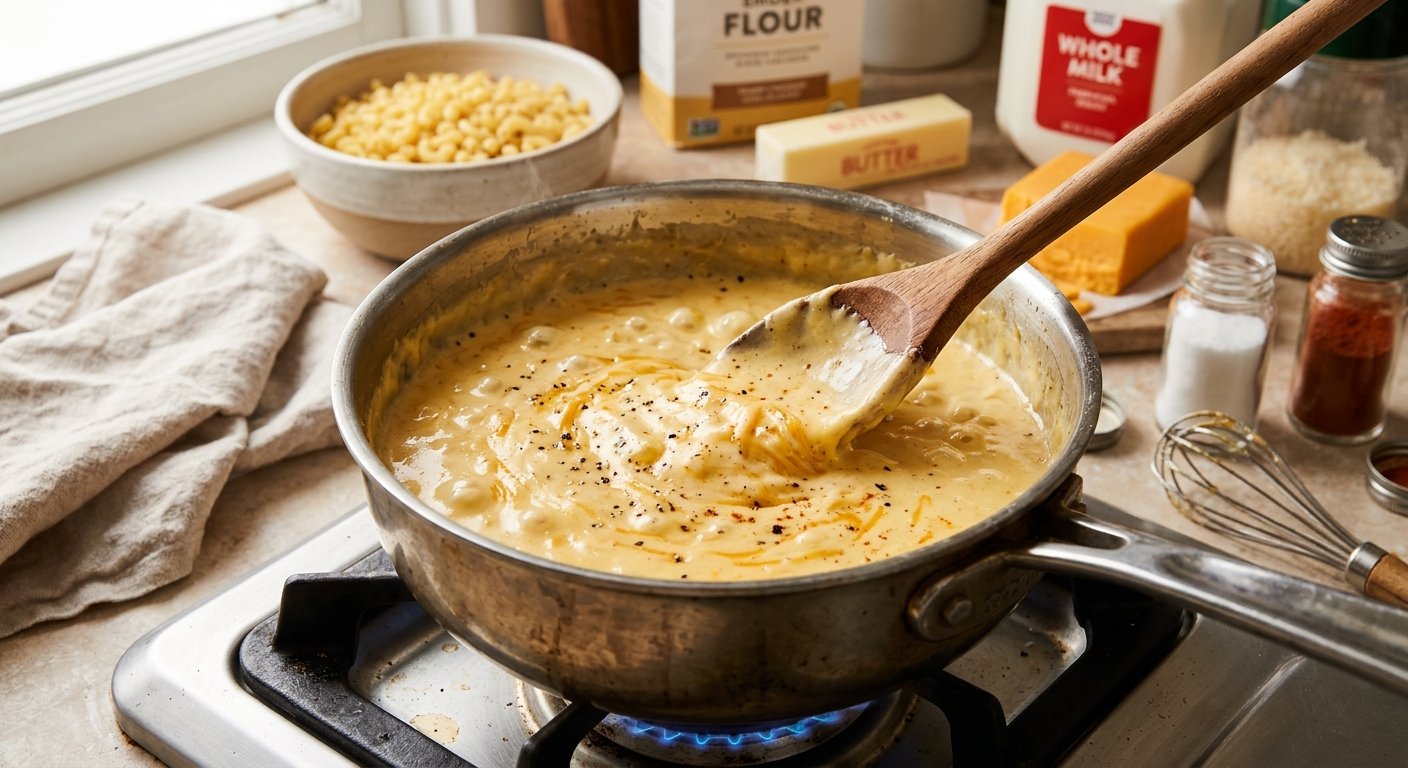
This Classic Mac and Cheese Sauce is rich, velvety and wonderfully cheesy, making it the perfect base for a comforting homemade meal. Made with butter, flour, milk, sharp cheddar and Parmesan, it creates a smooth sauce that coats pasta beautifully. A touch of paprika or mustard powder adds extra flavour without overpowering the cheese.
The secret to a silky cheese sauce is a well-made roux and gentle heat when adding the cheese. With a few simple ingredients and only a short time on the stove, you can prepare a versatile sauce for macaroni, pasta bakes, vegetables and more.
Whether you serve it immediately over freshly cooked pasta or use it in a golden oven-baked casserole, this homemade cheese sauce is an easy way to bring comfort and flavour to the table.
Melt the butter in a medium saucepan over medium heat.
Add the flour and whisk continuously for 1–2 minutes until smooth, bubbly and lightly golden.
Avoid allowing it to brown too much.
Add the milk:
Gradually pour in the milk while whisking continuously to prevent lumps.
Continue stirring for 3–5 minutes until the sauce thickens enough to coat the back of a spoon.
Melt the cheese:
Reduce the heat to low or remove the saucepan from the heat.
Add the cheddar and Parmesan, if using, a handful at a time.
Stir gently until the cheese has melted and the sauce is smooth.
Season the sauce:
Add the salt, black pepper and optional paprika or mustard powder.
Stir well, taste and adjust the seasoning as needed.
Adjust the consistency:
If the sauce is too thick, whisk in a small splash of warm milk.
If it is too thin, return it to low heat and stir gently for another minute or two.
Serve or combine with pasta:
Pour the warm sauce over freshly cooked macaroni or your favourite pasta and stir until evenly coated.
Serve immediately, or transfer to a baking dish with cooked pasta and finish in the oven for a golden topping.
Perfect for pasta, baked dishes, or even as a dip for veggies and fries. 😊
Why You’ll Love This Classic Mac and Cheese Sauce Recipe
Rich and creamy: Butter, milk and melted cheese create a smooth, velvety texture.
Full of cheesy flavour: Sharp cheddar provides a delicious savoury taste, while Parmesan adds extra depth.
Quick to prepare: This homemade sauce comes together in approximately 15 minutes.
Versatile: Use it for macaroni, pasta bakes, vegetables, loaded fries and more.
Easy to customise: Experiment with different cheeses, spices and additions to suit your taste.
Made with simple ingredients: No complicated ingredients are needed for a delicious homemade cheese sauce.
Tips for the Best Classic Mac and Cheese Sauce
Warm the milk: Slightly warmed milk blends more easily into the roux and helps prevent lumps.
Whisk continuously: Add the milk gradually while whisking to create a smooth, even sauce.
Cook the roux properly: Allow the butter and flour to cook for 1–2 minutes to remove the raw flour taste.
Grate your own cheese: Cheese grated from a block generally melts more smoothly than pre-shredded cheese.
Keep the heat low: High temperatures can cause melted cheese to separate or become grainy.
Add cheese gradually: Stir in small handfuls and allow each addition to melt before adding more.
Season carefully: Cheddar and Parmesan can already be salty, so taste the sauce before adding extra salt.
Adjust before serving: Add warm milk a little at a time if the sauce becomes too thick.
Serve while warm: Cheese sauce thickens as it cools, so serve it soon after preparation for the best consistency.
Choose pasta that holds sauce: Macaroni, shells, fusilli and cavatappi are all excellent choices.
Uses for This Classic Mac and Cheese Sauce Recipe
This homemade Classic Mac and Cheese Sauce is useful for much more than traditional macaroni and cheese. Its smooth texture and savoury flavour make it a versatile addition to everyday meals.
Classic macaroni and cheese: Stir through cooked elbow macaroni for a comforting family favourite.
Baked mac and cheese: Combine with cooked pasta, transfer to a baking dish, top with breadcrumbs and bake until golden.
Pasta casseroles: Mix with cooked pasta, vegetables and chicken or tuna for a hearty oven-baked meal.
Vegetable topping: Pour over steamed broccoli, cauliflower, carrots or green beans.
Loaded baked potatoes: Spoon over baked potatoes and finish with spring onions or crispy bacon.
Cheesy fries: Drizzle over hot chips or potato wedges for an indulgent side dish.
Nachos: Use as a creamy cheese topping with tortilla chips, salsa and your favourite extras.
Sandwich filling: Add a little sauce to toasted sandwiches or grilled cheese for an extra-cheesy finish.
Stuffed vegetables: Use as part of the filling for baked peppers or mushrooms.
Warm dip: Serve in a small bowl with vegetable sticks, breadsticks or pretzels.
Breakfast dishes: Spoon over scrambled eggs or add to breakfast wraps with cooked potatoes and vegetables.
Meal preparation: Make the sauce ahead and use it as a base for quick pasta and vegetable dishes.
Storage and Reheating
Cheese sauce is at its best freshly made, but you can store leftovers and use them in other meals.
Refrigeration: Allow the sauce to cool slightly, transfer it to an airtight container and refrigerate within 2 hours. Use within 3–4 days.
Reheating: Warm gently in a saucepan over low heat, whisking regularly. Add a splash of milk to loosen the sauce and restore its creamy consistency.
Microwave: Place a portion in a microwave-safe bowl and heat in short intervals, stirring between each interval until hot throughout.
Freezing: Freezing is possible, but the sauce may separate or become grainy after thawing. For the best texture, use it freshly made or refrigerated.
Make-ahead preparation: You can prepare the sauce a day ahead and refrigerate it. Reheat gently with a little milk before combining it with freshly cooked pasta.
What to Serve with Classic Mac and Cheese Sauce
The rich, cheesy flavour of this sauce pairs beautifully with fresh vegetables, grilled proteins, crisp salads and savoury breads.
Protein Pairings
Grilled chicken: Simply seasoned chicken makes a delicious main dish alongside cheesy pasta.
Barbecue pulled chicken: The smoky, savoury flavour contrasts nicely with the creamy sauce.
Grilled steak: Serve with a small portion of macaroni and cheese for a hearty meal.
Crispy bacon: Sprinkle cooked bacon pieces over the finished dish for extra savoury flavour.
Black bean patties: A satisfying vegetarian option with a different texture.
Vegetable Sides
Roasted broccoli: Its slightly crisp edges and savoury flavour complement the cheese sauce.
Brussels sprouts: Roast until tender and lightly caramelised for a delicious contrast.
Tomato and cucumber salad: A fresh salad with a light vinaigrette helps balance the richness.
Garlic sautéed spinach: Earthy greens add freshness to the meal.
Grilled vegetables: Peppers, courgettes and aubergines make colourful accompaniments.
Breads and Crunchy Sides
Garlic bread: Perfect for enjoying any extra sauce.
Herb focaccia: Soft bread with fresh herbs makes a lovely addition.
Buttery cornbread: A slightly sweet and savoury side that pairs well with macaroni and cheese.
Potato wedges: Golden wedges are delicious with a warm bowl of cheese sauce.
Fresh and Light Accompaniments
Green salad: Crisp lettuce, cucumber and a simple dressing provide freshness.
Coleslaw: A crunchy, tangy side balances the creamy cheese.
Tomato salad: Fresh tomatoes with herbs and a little vinegar add brightness.
Steamed green beans: A simple vegetable side that works well with rich pasta dishes.
Here are some fun variations to experiment with for your Classic Mac and Cheese Sauce recipe:
This Classic Mac and Cheese Sauce is easy to adapt with different cheeses, spices, vegetables and toppings.
Variations
🧀 Cheese Remix
Smoked Gouda Sauce: Replace some of the cheddar with smoked Gouda for a deeper, smoky flavour.
Three-Cheese Sauce: Combine cheddar, Parmesan and Gruyère for a more complex cheese flavour.
Fontina Cheese Sauce: Use Fontina in place of some of the cheddar for a particularly smooth, creamy result.
Cream Cheese Sauce: Stir in a spoonful of cream cheese for extra richness and a gentle tang.
Blue Cheese Sauce: Add a small amount of crumbled blue cheese for a bold, savoury variation.
🌶️ Flavor Boosters
Roasted Garlic: Stir in mashed roasted garlic for a mellow, savoury flavour.
Mustard and Paprika: Add Dijon mustard or mustard powder with a little smoked paprika.
Chilli Cheese Sauce: Add chilli flakes or a dash of hot sauce for gentle heat.
Truffle Cheese Sauce: Finish with a few drops of truffle oil for an earthy aroma.
Herb Cheese Sauce: Add chopped parsley, thyme or chives for freshness.
🥓 Mix-Ins & Toppings
Bacon and Cheese: Stir through cooked, crumbled bacon before serving.
Caramelised Onion: Add slowly cooked onions for a sweet, savoury flavour.
Mushroom Cheese Sauce: Fold in sautéed mushrooms for extra depth.
Crispy Breadcrumb Topping: Sprinkle panko breadcrumbs over a pasta bake before baking until golden.
Fresh Herbs: Finish with parsley or spring onions for colour and freshness.
🥦 Veggie Add-Ins
Broccoli and Cheese: Stir steamed broccoli florets into the sauce for a classic combination.
Spinach and Cheese: Fold in wilted spinach just before serving.
Cauliflower Cheese: Pour the sauce over cooked cauliflower and bake until bubbling.
Butternut Cheese Sauce: Blend a little cooked butternut into the sauce for a subtle sweetness.
Peas and Sweetcorn: Add peas or sweetcorn to macaroni for extra colour and texture.
🍝 Pasta Play
Shells: Their shape holds plenty of creamy sauce.
Cavatappi: Twisted pasta creates a satisfying texture in baked dishes.
Fusilli: The spirals catch the sauce beautifully.
Penne: A practical choice for pasta bakes and casseroles.
Wholewheat Pasta: Use wholewheat pasta for a nuttier flavour.
Final Thoughts
This Classic Mac and Cheese Sauce is a simple homemade staple that delivers rich, cheesy flavour and a wonderfully smooth texture. With a buttery roux, creamy milk and a combination of cheddar and Parmesan, it is an easy recipe that can turn ordinary pasta and vegetables into comforting meals.
Keep it classic with macaroni, bake it with a golden breadcrumb topping or experiment with different cheeses and flavour additions. Once you have mastered this versatile sauce, you will find plenty of delicious ways to use it in your kitchen.
Frequently Asked Questions
Why is my cheese sauce lumpy?
Lumps usually form when the milk is added too quickly or is not whisked into the roux properly. Pour in the milk gradually while whisking continuously. If small lumps remain, whisk vigorously or carefully blend the sauce until smooth.
Why has my cheese sauce become grainy?
Cheese sauce can become grainy when it gets too hot after the cheese has been added. Remove the saucepan from the heat before stirring in the cheese, and allow it to melt gently.
Can I make this sauce without Parmesan?
Yes. Parmesan is optional and adds extra savoury depth, but sharp cheddar alone makes a delicious cheese sauce. You can replace the Parmesan with a little more cheddar if preferred.
Can I use a different type of cheese?
Absolutely. Gouda, Gruyère and Fontina are good options. For the best texture, choose cheeses that melt well and combine them with cheddar for a balanced flavour.
Can I make this cheese sauce ahead of time?
Yes. Prepare the sauce, cool it promptly and refrigerate it in an airtight container. Reheat gently over low heat, whisking in a little milk to restore its smooth consistency.
How do I make the sauce thicker?
Allow the sauce to simmer gently for another minute or two before adding the cheese. It will also thicken as it cools. Avoid adding extra flour directly to the finished sauce, as it can create lumps.
How do I make the sauce thinner?
Whisk in a little warm milk until the sauce reaches your preferred consistency. Add it gradually so the sauce does not become too thin.
Can I use this sauce for vegetables?
Yes. It is delicious poured over steamed broccoli, cauliflower, carrots and other vegetables. You can also transfer the vegetables to a baking dish, cover them with the sauce and bake until bubbling.
Essential cookies enable basic functions and are necessary for the proper function of the website.
Name
Description
Duration
Cookie Preferences
This cookie is used to store the user's cookie consent preferences.
30 days
These cookies are needed for adding comments on this website.
Name
Description
Duration
comment_author
Used to track the user across multiple sessions.
Session
comment_author_email
Used to track the user across multiple sessions.
Session
comment_author_url
Used to track the user across multiple sessions.
Session
Google's current Sign in with Google client library. It renders the Google sign-in button, or the One Tap prompt, so visitors can log in to your site with their Google account. It replaces the older Google Sign-In platform library.
Set on your own domain by the Sign in with Google client library. Records whether the visitor has dismissed the One Tap sign-in prompt and for how long it should stay hidden, plus the time the library last loaded and a browsing session id used for the same purpose. Sites that pass a custom state_cookie_name will see that name instead.
180 days
g_csrf_token
Set on your own domain by the Sign in with Google client library and submitted together with the sign-in credential, so your site can confirm the sign-in came from its own page and not from a forged cross-site request.
5 minutes
Statistics cookies collect information anonymously. This information helps us understand how visitors use our website.
Google Analytics is a powerful tool that tracks and analyzes website traffic for informed marketing decisions.
Contains information related to marketing campaigns of the user. These are shared with Google AdWords / Google Ads when the Google Ads and Google Analytics accounts are linked together.
90 days
__utma
ID used to identify users and sessions
2 years after last activity
__utmt
Used to monitor number of Google Analytics server requests
10 minutes
__utmb
Used to distinguish new sessions and visits. This cookie is set when the GA.js javascript library is loaded and there is no existing __utmb cookie. The cookie is updated every time data is sent to the Google Analytics server.
30 minutes after last activity
__utmc
Used only with old Urchin versions of Google Analytics and not with GA.js. Was used to distinguish between new sessions and visits at the end of a session.
End of session (browser)
__utmz
Contains information about the traffic source or campaign that directed user to the website. The cookie is set when the GA.js javascript is loaded and updated when data is sent to the Google Anaytics server
6 months after last activity
__utmv
Contains custom information set by the web developer via the _setCustomVar method in Google Analytics. This cookie is updated every time new data is sent to the Google Analytics server.
2 years after last activity
__utmx
Used to determine whether a user is included in an A / B or Multivariate test.
18 months
_ga
ID used to identify users
2 years
_gali
Used by Google Analytics to determine which links on a page are being clicked
30 seconds
_ga_
ID used to identify users
2 years
_gid
ID used to identify users for 24 hours after last activity
24 hours
_gat
Used to monitor number of Google Analytics server requests when using Google Tag Manager
1 minute
Marketing cookies are used to follow visitors to websites. The intention is to show ads that are relevant and engaging to the individual user.
Google Ads is an online advertising platform that enables businesses to create targeted ads displayed on Google search results and partner sites.
Targeting cookie. Used to create a user profile and display relevant and personalised Google Ads to the user.
2 years
__Secure-1PSIDCC
Targeting cookie. Used to create a user profile and display relevant and personalised Google Ads to the user.
2 years
__Secure-3PAPISID
Profiles the interests of website visitors to serve relevant and personalised ads through retargeting.
2 years
AEC
AEC cookies ensure that requests within a browsing session are made by the user, and not by other sites. These cookies prevent malicious sites from acting on behalf of a user without that user's knowledge.
6 months
ADS_VISITOR_ID
Cookie required to use the options and on-site web services
2 months
__Secure-3PSIDCC
Targeting cookie. Used to create a user profile and display relevant and personalised Google Ads to the user.
2 years
__Secure-3PSIDTS
Targeting cookie. Used to create a user profile and display relevant and personalised Google Ads to the user.
2 years
__Secure-1PSIDTS
Targeting cookie. Used to create a user profile and display relevant and personalised Google Ads to the user.
2 years
__Secure-1PAPISID
Targeting cookie. Used to create a user profile and display relevant and personalised Google Ads to the user.
2 years
__Secure-3PSID
Targeting cookie. Used to profile the interests of website visitors and display relevant and personalised Google ads.
2 years
Conversion
Google uses cookies for advertising, including serving and rendering ads, personalizing ads (depending on your ad settings at g.co/adsettings), limiting the number of times an ad is shown to a user, muting ads you have chosen to stop seeing, and measuring the effectiveness of ads.
90 days
_gcl_aw
Google uses cookies for advertising, including serving and rendering ads, personalizing ads (depending on your ad settings at g.co/adsettings), limiting the number of times an ad is shown to a user, muting ads you have chosen to stop seeing, and measuring the effectiveness of ads.
90 Days
_gcl_gs
Google uses cookies for advertising, including serving and rendering ads, personalizing ads (depending on your ad settings at g.co/adsettings), limiting the number of times an ad is shown to a user, muting ads you have chosen to stop seeing, and measuring the effectiveness of ads.
90 Days
_gcl_gb
Google uses cookies for advertising, including serving and rendering ads, personalizing ads (depending on your ad settings at g.co/adsettings), limiting the number of times an ad is shown to a user, muting ads you have chosen to stop seeing, and measuring the effectiveness of ads.
90 Days
_gac_gb_
Google uses cookies for advertising, including serving and rendering ads, personalizing ads (depending on your ad settings at g.co/adsettings), limiting the number of times an ad is shown to a user, muting ads you have chosen to stop seeing, and measuring the effectiveness of ads.
90 Days
FPGCLGB
Google uses cookies for advertising, including serving and rendering ads, personalizing ads (depending on your ad settings at g.co/adsettings), limiting the number of times an ad is shown to a user, muting ads you have chosen to stop seeing, and measuring the effectiveness of ads.
90 Days
FPGCLAW
Google uses cookies for advertising, including serving and rendering ads, personalizing ads (depending on your ad settings at g.co/adsettings), limiting the number of times an ad is shown to a user, muting ads you have chosen to stop seeing, and measuring the effectiveness of ads.
90 Days
You can find more information in our Cookie Policy and .